

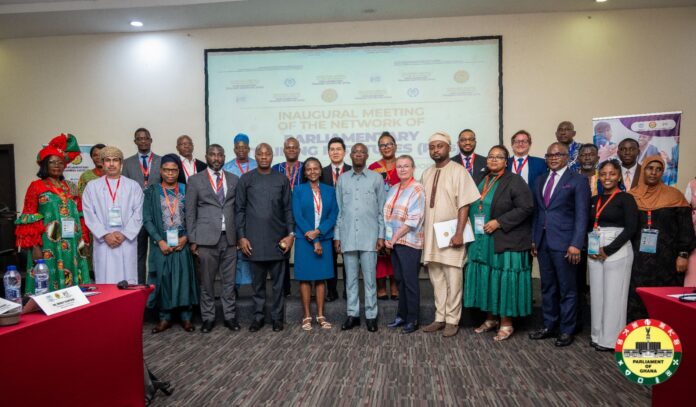

The Parliamentary Training Institute of Ghana has hosted the inaugural meeting of the Network of Parliamentary Training Institutes (PTIs), bringing together key stakeholders to promote peer learning and institutional collaboration across parliaments.
The meeting, held under the theme “Peer Learning and Networking,” aims to strengthen parliamentary institutions through knowledge-sharing and coordinated capacity development initiatives.
Delivering the keynote address on behalf of the Speaker, the First Deputy Speaker, Hon. Bernard Ahiafor, commended the Inter-Parliamentary Union, the Centre for Parliamentary Studies and Training, and Ghana’s Parliamentary Training Institute for organizing what he described as a timely and strategic initiative.
Also read: SIM re-registration plan gets Parliamentary backing over fraud concerns
He noted that Parliamentary Training Institutes serve as the backbone of sustainable capacity development, acting as critical engines for enhancing the effectiveness of legislatures.
“These institutes play a central role in democratic governance by supporting Members of Parliament, parliamentary staff, researchers, clerks, and committees,” he said.
Ahiafor added that the meeting provides an opportunity for participants to reflect on shared experiences and deepen collaboration.
“No parliament has a monopoly on knowledge,” he emphasized.
The Majority Leader, Hon. Mahama Ayariga, underscored the importance of strong parliamentary institutions, noting that effectiveness goes beyond constitutional establishment.
“Capacity development must be treated as a core priority to ensure that MPs, staff, and administrators possess the necessary skills, knowledge, and values,” he stated.
Speaking on behalf of the Minority Leader, MP for Old Tafo, Hon. Vincent Ekow Assafuah, described the formation of the network as a necessity rather than a choice.
“Bringing together nearly thirty institutions provides a unique opportunity to promote peer learning, share best practices, and harmonize training approaches,” he noted.
He stressed that standardization should focus on coherence, ensuring a common baseline of competence, integrity, and responsibility across parliaments.
The Clerk to Parliament, Mr. Ebenezer Djietror, highlighted the increasing complexity of governance and the growing demands on parliaments to legislate, provide oversight, and engage citizens effectively.
“Capacity development has become essential not only for effectiveness but also for building public trust,” he said.
He described the PTIs Network as a vital platform for strengthening collaboration, addressing emerging challenges, and supporting modern, responsive parliamentary democracies.
The inaugural PTIs Network meeting marks a significant step toward strengthening parliamentary institutions through collaboration, shared learning, and sustained capacity development across jurisdictions.