

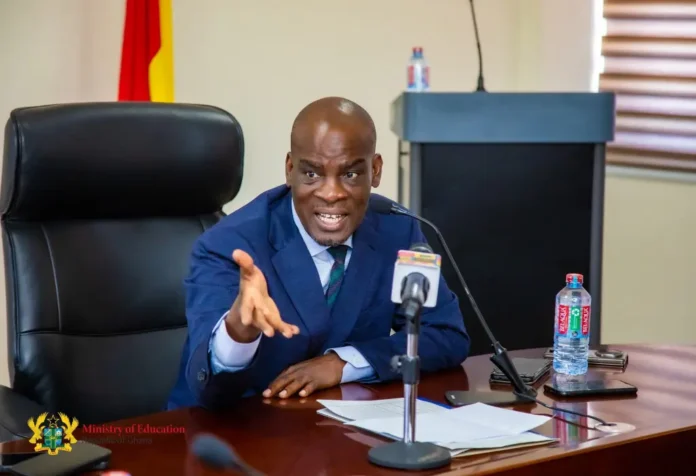

Minister for Education, Haruna Iddrisu, has defended the Ghana Tertiary Education Commission’s (GTEC) decision to deny graduates of unaccredited tertiary institutions access to national service, insisting that accreditation standards cannot be compromised.
The minister made the remarks in Parliament while responding to a question from the Member of Parliament for Offinso North, Dr Fred Kyei Asamoah, who sought clarification on why 22 institutions had been declared ineligible for national service and what measures the Ministry of Education was implementing to protect affected students.
Haruna Iddrisu explained that GTEC, established under the Education Regulatory Bodies Act, 2020 (Act 1023), is the sole statutory body mandated to regulate tertiary education institutions, assure quality and maintain internationally accepted academic standards.
Also read: Carlos Queiroz bows but, warns Black Stars’ future depends on structural reform
According to the minister, graduates from institutions that fail to obtain the required accreditation cannot legally be enrolled onto the National Service Scheme.
“Once you are not accredited, you are not accredited. We must ensure fidelity and respect to the laws of Ghana,” he told Parliament.
The Education Minister disclosed that the issues involving the 22 institutions referenced in the question had since been addressed, with the affected institutions obtaining the necessary accreditation, enabling their graduates to participate in national service.
However, Dr Kyei Asamoah questioned why GTEC had recently published another notice identifying about 60 additional institutions as unrecognised and unaccredited if the earlier problems had been resolved.
In response, Haruna Iddrisu maintained that the latest institutions cited by GTEC had failed to meet the commission’s minimum accreditation requirements.
He stressed that GTEC would continue enforcing both institutional and programme accreditation rules to safeguard the quality of tertiary education in Ghana.
“If accreditation fails, the quality of our graduates will suffer,” the minister stated.
He attributed many of the compliance challenges to some private tertiary institutions that continue to operate without fully meeting regulatory requirements.
The minister praised the Director-General of GTEC for rigorously enforcing the law, describing the commission’s actions as necessary to preserve academic standards.
Dr Kyei Asamoah called for stronger structural measures to prevent students from unknowingly enrolling in unaccredited institutions, while the Minister urged prospective students and parents to verify the accreditation status of institutions before seeking admission, insisting that private tertiary institutions must comply with the provisions of Act 1023.
He added that institutions seeking accreditation must satisfy both institutional and programme requirements before receiving approval from GTEC.
Haruna Iddrisu also cautioned against lowering accreditation standards, arguing that weak regulation could compromise the quality of professionals entering critical sectors such as healthcare.
Using nursing education as an example, he stressed that Ghana could not afford to produce inadequately trained professionals due to regulatory failures.
He noted that while government recognises the important role private universities play in expanding access to tertiary education, institutions that consistently fail to meet accreditation standards must either comply with the law or face closure.
The minister reaffirmed the government’s commitment to supporting GTEC in enforcing quality assurance measures across the country’s tertiary education sector.