

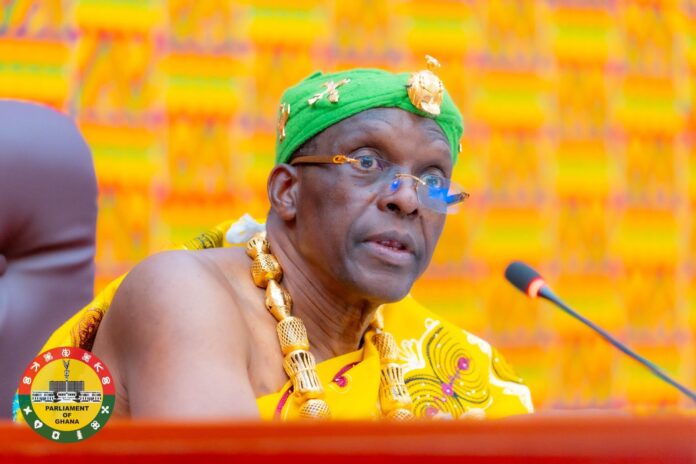

Speaker of Parliament, Alban Sumana Kingsford Bagbin, has urged Members of Parliament to approach the Tribunals Bill, 2026, with open minds rather than allowing historical perceptions to cloud their judgment.
He acknowledged that some Ghanaians remain opposed to tribunals because of their historical association with military rule but cautioned against dismissing the concept entirely.
The Speaker made the remarks on Wednesday during debate on the Report of the Joint Committee on Constitutional and Legal Affairs and Judiciary on the Tribunals Bill, following concerns raised by the Member of Parliament for Damongo, Samuel Abu Jinapor, who argued that regional tribunals evoke painful memories of the PNDC era.
Also read: Regional tribunals evoke painful PNDC era memories – Abu Jinapor warns against reintroduction
The Bill proposes the reintroduction and operationalisation of regional tribunals to handle certain criminal cases.
“There are people against it. Every lawyer knows that a tribunal is part of the justice system everywhere in the world,” the Speaker stated.
He argued that viewing every tribunal through the lens of past abuses amounts to prejudice and could undermine objective debate on an important piece of legislation.
According to him, tribunals remain an integral part of justice systems across the world, including traditional and international legal systems.
Speaker Bagbin stressed that the existence of abuses under previous tribunal systems should not lead Parliament to reject the concept altogether.
He pointed out that international tribunals continue to play significant roles in resolving disputes and administering justice globally.
“You can’t just generalise that once you hear the word tribunal, it’s something bad and it must be rejected,” he told the House.
The Speaker also cited traditional dispute resolution mechanisms, noting that tribunals exist within customary institutions and serve useful purposes when properly constituted.
Rt. Hon. Bagbin urged lawmakers to avoid what he described as “fundamentalism” in Ghana’s political discourse, saying rigid partisan positions often prevent consensus-building on important national issues.
He reminded MPs that Parliament has the constitutional responsibility to improve legislation where necessary rather than rejecting proposals based solely on historical experiences.
“If at the end of the day we decide that what they are proposing is not correct, it’s our duty. We make the law. We have to correct it,” he said.
The Speaker encouraged Members to scrutinise the bill thoroughly and remove any provisions that could permit abuse while preserving aspects that could strengthen Ghana’s justice delivery system.
The Tribunals Bill, 2026, has generated intense debate in Parliament, with the Majority arguing that regional tribunals will help expedite criminal trials and reduce case backlogs.
The Minority, however, contend that the country should instead strengthen existing courts, warning that regional tribunals could revive memories of politically controversial judicial structures that operated during previous military governments.