

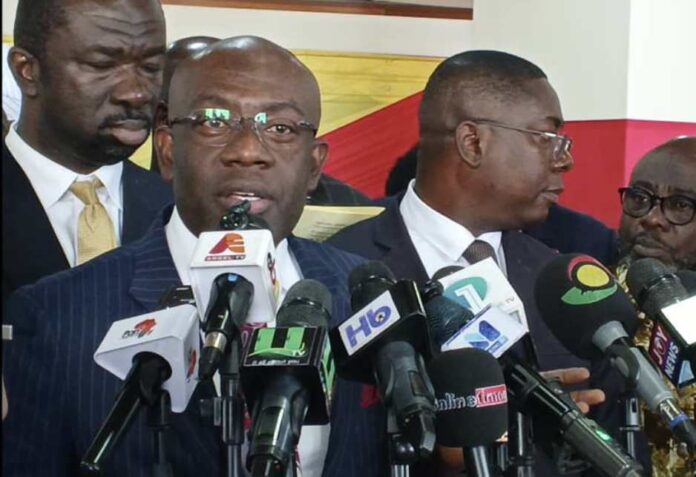

The Minority Caucus in Parliament has boycotted a Committee of the Whole meeting with Bank of Ghana (BoG) Governor Dr. Johnson Pandit Asiama, accusing the Majority of blocking media coverage of proceedings involving key questions on Ghana’s foreign exchange interventions and reserve management.
The Minority suspended its participation after the Majority allegedly requested that journalists leave the chamber before the Governor’s session
Speaking to journalists after the walkout, Kojo Oppong Nkrumah, Member of Parliament for Ofoase-Ayirebi and Ranking Member of Parliament’s Economy and Development Committee, said the decision undermined Parliament’s commitment to transparency and accountability.
Also read: World Population Day: Ghana’s youth is a ‘historic opportunity’ for growth – Patricia Appiagyei
“The Majority Caucus requested that the media be exited from the chamber because of the matters we were about to discuss with the Governor. We believe the people of Ghana deserve to hear these answers,” he said.
Mr. Oppong Nkrumah explained that he had filed three parliamentary questions seeking clarification from the BoG Governor on the country’s foreign exchange market interventions.
The questions sought to establish: The source of the foreign exchange used for market interventions;
The framework governing those interventions; and
The total amount injected into the foreign exchange market.
He argued that the issues were of significant public interest because they relate directly to Ghana’s external reserves and exchange rate management.
The Ofoase-Ayirebi MP disclosed that the Governor had already submitted written answers to Parliament before the meeting, indicating that since August 2024, the Bank of Ghana has not relied on its external reserves for direct foreign exchange market interventions.
Instead, he said the responses of the BoG Governor state that the interventions are financed through proceeds generated under the Domestic Gold Purchase Programme.
He questioned why the Majority would prevent journalists from covering information that had already been submitted to Parliament.
“The answers are already on the Order Paper. They are public documents. We do not understand why the media should be prevented from reporting them,” he stated.
The Minority also raised concerns about Ghana’s gross international reserves and the financial position of the central bank.
According to the caucus, the Bank of Ghana’s Monetary Policy Committee report for May 2026 placed gross international reserves at US$14.2 billion at the end of the first quarter.
However, the Minority claimed it had information suggesting the reserves had fallen to about US$12 billion by the end of June 2026.
The caucus said it intended to ask the Governor to confirm whether approximately US$2 billion had been used for foreign exchange market interventions.
The Minority argued that Parliament should be allowed to scrutinise the Bank of Ghana’s reported financial losses and reserve management strategy in an open session accessible to the public.
Mr. Oppong Nkrumah maintained that Parliament should remain transparent, particularly on matters involving the management of public finances.
He noted that previous Committee of the Whole meetings involving institutions such as the Electoral Commission had been open to media coverage.
“This is the People’s House. The people deserve to hear the answers to these important economic questions,” he said.
The Minority, he said, will continue engaging the Majority in an effort to have the proceedings opened to the media before participating in the session.