

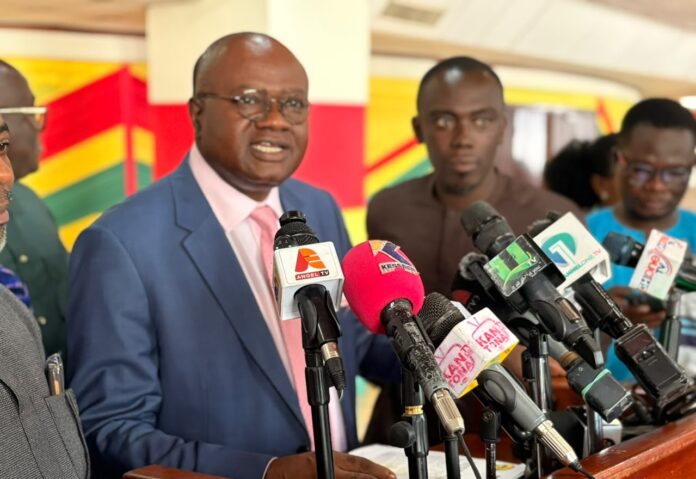

The Minority Caucus in Parliament has raised concerns over the ratification of six mining lease agreements, including the Damang mining lease, accusing the government and Majority of failing to subject the deals to the level of scrutiny required by the Constitution.
Parliament ratified the six mining leases on Thursday, July 30, 2026, covering mining operations in the Western, Central and Upper East regions.
The agreements involve Golden Star Wassa Limited at Wassa Akyempem in the Western Region; Maripoma Mining Services Limited at Zongoiri in the Upper East Region; two leases for Perseus Mining Limited at Ayamfuri and Nanankaw-Agyakusu; and two leases for Damang Gold Mine Limited, an SPV for Engineers and Planners Limited, at Damang in the Western Region.
Also read: Attorney-General rushes to court for stay of execution to block MASLOC ex-boss acquittal
Addressing the media in Parliament on Friday, Ranking Member of the Land and Natural Resources Committee, Kweku Ampratwum-Sarpong, described the process as a ‘rubber-stamp ratification of defective mining leases’ and warned that Parliament must not become a ‘conveyor belt’ for the disposal of Ghana’s mineral wealth.
The Ranking Member alleged that several concerns emerged during the committee’s consideration of the six mining leases.
According to him, some cadastral plans lacked mandatory signatures from the appropriate Regional Surveyors while others are allegedly improperly signed or did not contain the names and endorsements of relevant officials.
The Minority said the concerns are significant because cadastral plans are central to Ghana’s mineral rights administration and determine the location, size and legal boundaries of mining concessions.
It also alleged that some lease documents contained signatures without the names of the persons who executed them.
Hon. Ampratwum-Sarpong claimed that some companies failed to attach their Programmes of Mining Operations, limiting Parliament’s ability to properly assess how the mineral resources would be developed and managed.
Another major concern raised by the Minority is the alleged omission of Ghana’s statutory 10% free carried interest from several mining leases.
The caucus argued that the State’s free carried interest represents the direct stake of the Ghanaian people in the exploitation of the country’s mineral resources and should be reflected in mining agreements submitted to Parliament.
The Minority also questioned the alleged commencement or continuation of mining operations before parliamentary ratification.
It claimed that, except for Maripoma Mining Services Limited, almost all the companies involved had already commenced or continued mining before Parliament approved their leases.
The caucus cited Article 268(1) of the 1992 Constitution, which requires parliamentary ratification of mining agreements, and argued that parliamentary approval should not become a mere formality after mining operations have begun.
According to the Minority, allowing companies to mine first and seek approval later could reduce Parliament’s constitutional role to that of a rubber stamp.
The Ranking Member argued that the Damang Mine, an SPV for Engineers and Planners Limited founded by the President’s brother, raises eyebrows.
The relationship, he said, heightens public interest in the transaction and increases the need for transparent and independent scrutiny.
The Ranking member also argued that Parliament should have received the Minerals Commission’s Tender Committee Report, the complete Mining Lease Agreement and all related operating, transitional and ancillary agreements before approving the deal.
He demanded disclosure of the financial and commercial terms to determine whether Ghana is receiving fair value for the transfer of such a strategic national asset.
The Minority proposed that the government should have negotiated an increase in Ghana’s equity participation in the mine from 10% to between 20% and 30%.
It also called for detailed information on gold production, sales revenue, royalties, taxes and payments due to the State through its statutory free carried interest.
The caucus also criticised the committee process, alleging that its concerns were not fully reflected in the final report recommending ratification.