
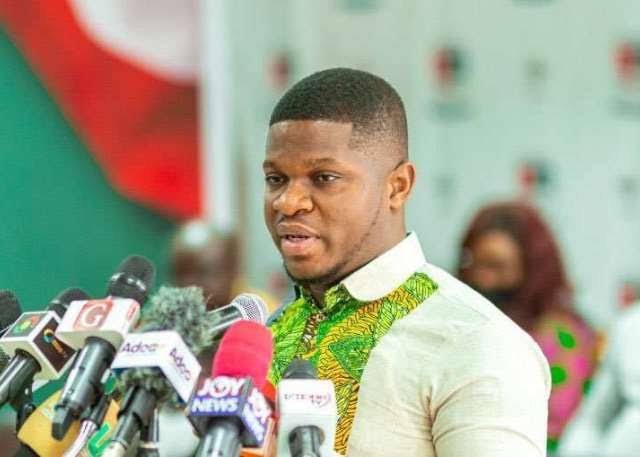

Ghana Gold Board (GoldBod) Chief Executive Officer Sammy Gyamfi has hit back at Minority Leader Alexander Afenyo-Markin, rejecting what he described as moral lectures from the opposition politician as the political battle over GoldBod and Ghana’s Domestic Gold Purchase Programme intensifies.
Mr Gyamfi, in a sharp response to the Minority Leader, said he would not accept moral lessons from Mr Afenyo-Markin, stating, “We won’t take moral lessons from a brothel.”
The latest exchange comes shortly after the Minority in Parliament renewed its demand for a full parliamentary investigation into an alleged GH¢22 billion loss linked to the Domestic Gold Purchase Programme in 2025.
Addressing the media on Tuesday, the Minority Caucus cited the International Monetary Fund’s (IMF) Sixth and Final Review of Ghana’s Extended Credit Facility programme, completed in July 2026.
According to the Minority, the IMF report indicates that the Domestic Gold Purchase Programme generated losses equivalent to about US$1.7 billion, or GH¢22 billion, in 2025, representing approximately 1.5% of Ghana’s GDP.
The Caucus insists that the issue should not be determined solely by whether GoldBod recorded the amount as a loss in its own financial statements.
It argued that GoldBod operated as a buying agent for the Bank of Ghana (BoG), with the central bank providing financing and carrying the major financial risks associated with the arrangement.
The Minority therefore wants authorities to provide detailed information on gold purchasing prices, premiums, off-takers, discounts, service and assay fees, and the risk-management mechanisms governing the programme.
Addressing the media at the government accountability series on Wednesday, Mr Gyamfi argued that GoldBod has been positioned by the government as a key institution for formalising gold trading, improving traceability, reducing smuggling and increasing Ghanaian participation in the gold value chain.
He argued that Ghana must move beyond exporting raw minerals and develop stronger domestic refining, processing and downstream industries.
Since its establishment, GoldBod has been promoted by the government as a key institution for transforming Ghana’s gold economy.
The institution is responsible for regulating and facilitating the purchase and sale of gold, particularly from the artisanal and small-scale mining sector.
Government officials argue that GoldBod is helping to reduce gold smuggling, improve traceability and ensure that more of the value generated from Ghana’s gold remains in the domestic economy.
The opposition, however, has raised questions about various aspects of the institution’s operations, finances and governance.
Those disagreements have increasingly spilled into public exchanges involving senior political figures and officials.
Mr Gyamfi has consistently defended the government’s approach, arguing that Ghana must move beyond simply extracting and exporting raw minerals and instead maximise local value addition.
He has also highlighted GoldBod’s role in increasing formal gold purchases, supporting local refining and creating opportunities for Ghanaian participation in the gold value chain.
At a recent National Mining Dialogue in Accra, Mr Gyamfi outlined his “Involve, Protect, Expand” (IPE) model for Ghana’s mining sector.
He argued that mining communities should become active economic participants rather than merely providing land for mining activities.
According to him, Ghana must increase indigenous ownership, expand local refining and downstream industries, protect the environment, and create greater opportunities for young people in mining communities.