
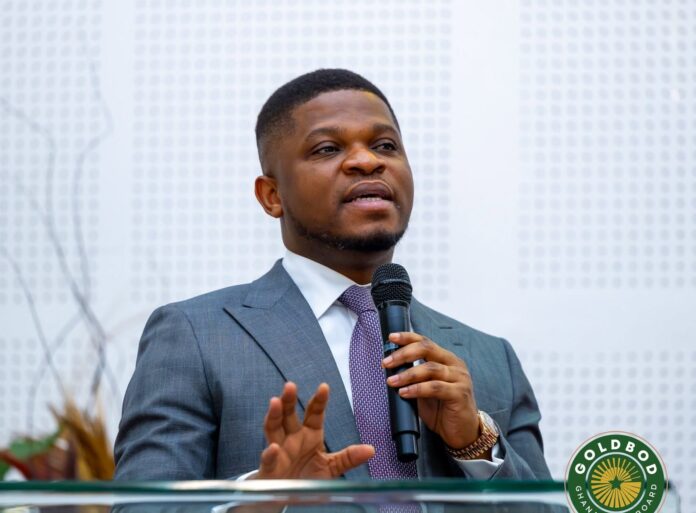

Ghana Gold Board (GoldBod) Chief Executive Officer Sammy Gyamfi has unveiled a transformative three-pronged framework to reshape Ghana’s mining future, prioritising community participation, environmental protection, and greater Ghanaian ownership.
The IPE model – Involve, Protect, and Expand – was presented at the National Mining Dialogue 2026 in Accra under the theme “Rethinking the Social Licence to Operate.”
Mr. Gyamfi argued that Ghana must move beyond an extractive mining model and build an industry that creates jobs, supports local businesses, protects the environment, and delivers tangible benefits to communities hosting mineral resources.
Also read: Ghana’s nuclear future: Why Small Modular Reactors could transform power generation – George Appiah
He stressed that the social licence to operate cannot survive where communities continue to experience poverty, unemployment, poor infrastructure, and inadequate basic services despite the wealth generated from their natural resources.
Explaining the “Involve” pillar, Gyamfi insisted that host communities should no longer be treated simply as land donors. Instead, they must become development partners and economic shareholders in the mineral wealth found in their communities.
He called for mining communities to have a stronger voice in decisions affecting mining activities, as well as clearer access to employment, contracts, skills training, and other economic opportunities.
“Mining communities must move from consultation to strategic partnerships,” he declared. Local royalty retention must be increased and decentralised so mining revenues can have greater impact at the community level. He further proposed that every new mine should come with clear commitments on local jobs, infrastructure, services, and enterprise development.
Under ‘Expand’, Sammy Gyamfi emphasised that Ghana must deliberately increase indigenous participation across the mining value chain. Despite more than a century of commercial gold mining, too much ownership, financing, refining, services, and downstream activity remains outside Ghana. The country must own more, refine more, process more, fabricate more, and retain more value from its mineral resources.
Ghanaian capital should be supported to participate in exploration, mine development, mining services, and downstream industries. He identified opportunities for communities and young people in logistics, equipment maintenance, environmental services, catering, transport, fabrication, and other mining-related businesses.
He disclosed that nearly nine tonnes of gold aggregated by GoldBod had been refined in Ghana in 2026, creating jobs and retaining refining-related economic benefits domestically. He also announced plans for a Ghana Gold Village to support jewellery manufacturing, gold fabrication, skills development, and access to international markets through GoldBod Jewelry Limited.
Under the “Protect” pillar, Gyamfi stated that Ghana’s water bodies, forests, farmlands, and public health must be treated as non-negotiable national assets. “The social licence of a mining future cannot coexist with poisoned rivers and devastated forest reserves,” he said. He called for effective enforcement of environmental regulations, mandatory reclamation and reforestation, and prosecution of individuals responsible for illegal and destructive mining.
GoldBod has commenced reclamation of 50 hectares of degraded land in the Tano Nimri Forest Reserve and plans to cover another 100 hectares next year. The institution is also funding rehabilitation of three water treatment plants serving more than 76 communities and approximately 100,000 users.
Gyamfi described the youth question as central to Ghana’s mining future. Young people in mining communities should have opportunities to become geologists, engineers, environmental scientists, equipment operators, jewellers, entrepreneurs, and mine owners.
“A young person in Tarkwa, Obuasi, Prestea, Bibiani or Ahafo should see mining not as a distant concession, but as a chain of opportunities,” he said.
Explaining artisanal and small-scale mining (ASM), he noted that ASM accounts for 52.4 per cent of Ghana’s total gold production.
GoldBod has facilitated the formal export of about 170 tonnes of ASM gold since 2025, generating over US$17 billion in foreign exchange. An ASM Formalisation and Financing Support Programme is planned for 2027, alongside a technology-driven traceability system to strengthen accountability.
The Goldbod CEO stressed that the IPE model is ultimately about rebuilding trust among mining companies, communities, government, and stakeholders.
“If we get this right, Ghana will not only produce gold. Ghana will produce prosperous mining towns, strategic industries around its minerals and deeper community trust,” he said.
He urged stakeholders to make Involve, Protect and Expand a national commitment capable of transforming Ghana’s mining future for current and future generations.