

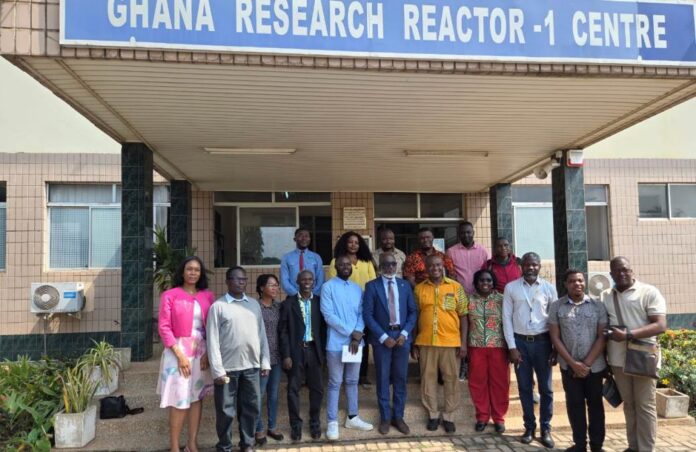

Ghana’s nuclear energy programme has taken another step forward as experts at the Ghana Atomic Energy Commission (GAEC) showcased the country’s capabilities in reactor training, radioactive waste management and radiation-based scientific research.
The demonstration formed part of a media engagement organised by Nuclear Power Ghana (NPG) on August 18, 2026, to deepen journalists’ understanding of nuclear technology and Ghana’s preparations to introduce nuclear power into its energy mix.
Practitioners of the Media for Nuclear Power Project visited the NuScale E2 Small Modular Reactor (SMR) simulator at the Atomic-Kwabenya enclave before touring key facilities at GAEC, including the Centralised Radioactive Waste Management Facility and Reactor Hall.
Also read: Government sets 24-month deadline for Big Push roads, targets 2027 completion
The engagement provided journalists with practical insights into reactor safety, the management of disused radioactive sources and the growing applications of radiation technology in healthcare, agriculture, food processing, mining, oil and gas and scientific research.
George Kofi Appiah, Manager of the Localization and Stakeholder Support Centre at the Nuclear Power Institute, used the reactor simulator to explain how nuclear power plant operators monitor and control reactor operations.
He explained that control rods play a critical role in regulating a nuclear chain reaction by absorbing neutrons, while fuel assemblies, temperature controls and real-time power monitoring systems help maintain reactor stability.
The simulator demonstration was designed to demystify nuclear technology and show how reactor operations are governed by multiple engineering and safety systems.
Mr Appiah also highlighted the potential role of small modular reactors in Ghana’s future energy mix, noting their potential advantages in areas such as cost, maintenance and deployment.
He, however, stressed that the long-term sustainability of nuclear technology would depend heavily on a strong maintenance culture and the development of skilled local personnel.
He explained that the Small Modular Reactor Simulator was developed through a collaboration between Ghana and the United States and is the first of its kind in Africa.
The facility is expected to support nuclear workforce training and research as Ghana continues preparations towards the introduction of nuclear power.
At the Centralised Radioactive Waste Management Facility (CRWMF), operated by the Radioactive Waste Management Centre under the Radiation Protection Institute of GAEC, Senior Research Scientist Gustav Kudjoe Gbeddy explained how Ghana manages radioactive materials that have reached the end of their useful life.
Mr Gbeddy, who specialises in radioactive waste management, analytical chemistry and environmental protection, said radioactive sources cannot be discarded as ordinary waste once they become disused.
He explained that users may, where possible, return radioactive sources to their original suppliers or countries of origin after obtaining the necessary regulatory approvals.
Where returning the sources is not feasible, the materials can be transferred through the Nuclear Regulatory Authority to GAEC for controlled management.
The scientist said the amount and nature of radioactive waste generated in Ghana vary depending on the sectors in which radioactive sources are used.
Much of the waste handled by the centre comes from healthcare facilities, particularly sources associated with cancer treatment and nuclear medicine.
Radioactive materials are also used in beverage production, road construction, mining, oil and gas, non-destructive testing and other industrial applications.
Mr Gbeddy said the management of radioactive waste considers factors such as the activity of the source and its half-life. While some radioactive materials decay relatively quickly, others can remain hazardous for extremely long periods.
“Some can take millions of years to decay. Some can just decay within a matter of days,” he explained.
Once a disused radioactive source is accepted for management, trained personnel dismantle the equipment and carefully remove the radioactive material.
The source is placed in specially designed stainless-steel capsules and shielded with appropriate materials to contain radiation and protect workers and the environment.
The remaining equipment is subjected to contamination tests to ensure that no radioactive material remains on its surface before it can potentially be released as ordinary scrap.
Mr Gbeddy said Ghana’s final disposal system for radioactive sources is not yet operational, meaning some disused sources are currently maintained in controlled storage as an interim measure.
He said the sources are properly identified, monitored and kept under regulatory control.
At Reactor Hall 1, GAEC Research Scientist Dr Kwame Gyamfi demonstrated how radiation-based techniques are being used to support scientific research in Ghana.
He explained that researchers can use nuclear techniques to identify and measure elements in food, water, soil, rocks, alloys and other materials.
The applications cut across mining, agriculture, healthcare, metallurgy, environmental studies and food research.
According to Dr Gyamfi, samples must first be carefully prepared before irradiation.
Solid food and other non-liquid samples may be converted into powder, while samples can be frozen and placed in a freeze dryer to remove moisture without applying heat.
The media engagement provided journalists with a practical understanding of the infrastructure and expertise supporting Ghana’s nuclear energy programme ambition.
The demonstrations showed that nuclear technology extends beyond electricity generation and has applications in healthcare, agriculture, food safety, mining, manufacturing, environmental protection and scientific research.
The engagement also highlighted the importance of developing a skilled workforce, strengthening regulatory systems and maintaining high safety standards as Ghana prepares to add nuclear power to its energy mix.
For Nuclear Power Ghana and GAEC, greater public and media understanding is considered essential to ensuring informed national discussion as the country advances its nuclear energy programme