

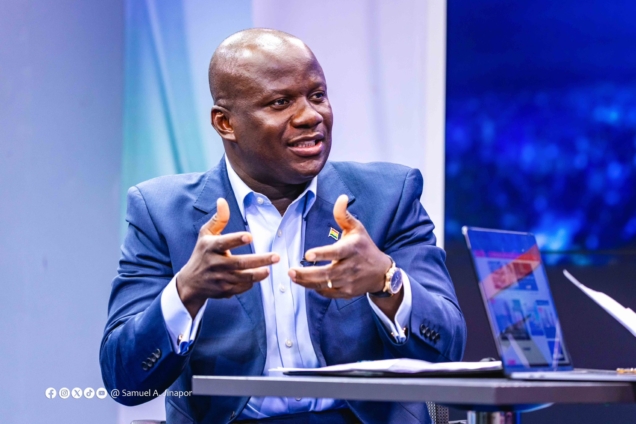

Former Minister for Lands and Natural Resources Samuel Abu Jinapor has mounted a strong defence of former Vice President Dr Mahamudu Bawumia’s role in the introduction of Ghana’s Domestic Gold Purchase Programme (DGPP).
Mr Jinapor, who served as Lands and Natural Resources Minister when the programme was introduced, said the initiative was conceived by Dr Bawumia at a time Ghana was grappling with severe economic challenges caused by the COVID-19 pandemic and the Russia-Ukraine war.
In a statement issued in response to recent comments about the programme, Mr Jinapor said Dr Bawumia, who was then Head of the Economic Management Team, initiated discussions with relevant stakeholders before directing the Ministry of Lands and Natural Resources to engage key players in the sector.
Also read: Cybersecurity Authority warns as Ghana records 24,778 fraud cases in 2025
The programme was subsequently launched on June 17, 2021, at the then headquarters of the Bank of Ghana.
Mr Jinapor said the initiative represented a major shift in Ghana’s approach to building its gold and foreign exchange reserves because, for the first time, the government was purchasing gold locally for reserve accumulation.
He explained that the Bank of Ghana purchased gold from licensed aggregators and mining companies and paid them the Ghana cedi equivalent of the prevailing market price.
According to Mr Jinapor, Ghana had only 8.77 tonnes of gold in its reserves when the programme was launched.
He said the Bank of Ghana had initially set a target of doubling the country’s gold reserves within five years.
However, by December 2024, the reserves had risen to 30.53 tonnes, representing almost a fourfold increase in less than four years.
Mr Jinapor described the development as evidence of the significant impact of the Domestic Gold Purchase Programme on Ghana’s reserve accumulation.
He outlined measures taken by the Ministry to support the programme, including the use of the government’s pre-emptory right under Section 7 of the Minerals and Mining Act, 2006 (Act 703).
On November 23, 2023, the Ministry issued policy directives requiring large-scale mining companies to sell 20% of their refined gold to the Bank of Ghana in Cedis before exporting the remainder.
Community Mining Schemes and licensed small-scale miners were also directed to sell their gold to the government through the then Precious Minerals Marketing Company (PMMC).
Mr Jinapor stressed that the policy focused on licensed and responsible small-scale miners to prevent illegally sourced gold from entering the programme.
The former minister also pointed to Ghana’s gold export figures as part of the broader impact of the sector’s policies.
He said gold exports reached a record US$11.6 billion in 2024, compared with US$7.6 billion in 2023 and US$6.6 billion in 2022.
Mr Jinapor further cited comments by Bank of Ghana Governor Dr Johnson Asiama at the 77th Annual New Year School and Conference in January 2026.
According to Mr Jinapor, the Governor said the Domestic Gold Purchase Programme had strengthened Ghana’s external buffers and contributed to macroeconomic stability.
Mr Jinapor linked the current government’s Ghana Accelerated National Reserve Accumulation Policy (GANARAP) to the previous Domestic Gold Purchase Programme.
He argued that GANARAP was essentially a renamed version of the earlier initiative.
“This Government’s ‘Ghana Accelerated National Reserve Accumulation Policy (GANARAP),’ is nothing more than a renaming of the Domestic Gold Purchase Programme,” he said.
He alleged that the current policy had resulted in the sale of more than half of the gold accumulated under the Akufo-Addo/Bawumia administration.
Mr Jinapor called for the historical record to properly recognise Dr Bawumia’s contribution to the initiative.
“Let the public record of our country reflect that the Domestic Gold Purchase Programme, which has resulted in the exponential increase of the reserves of the Central Bank of our country and contributed significantly to our national economy, was the brainchild of H.E Dr. Mahamadu Bawumia,” he stated.