

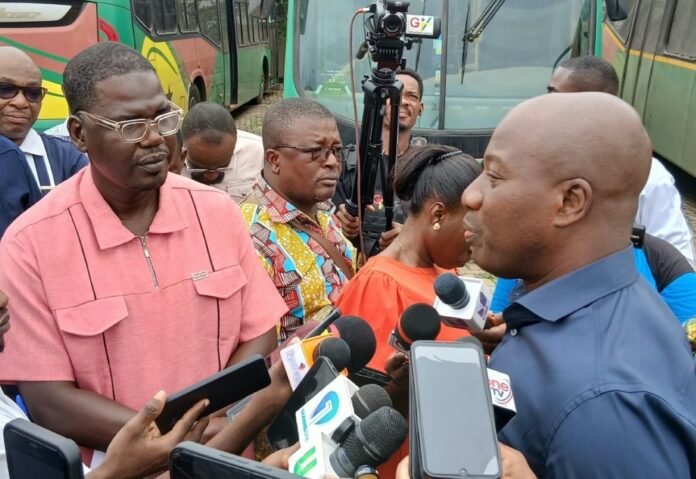

Minister for Local Government, Chieftaincy and Religious Affairs, Mahama Ayariga, has outlined a bold plan to transform Ayalolo buses into a genuinely rapid public transport system to help tackle traffic congestion in Accra and other major cities.
He identified Greater Accra, Greater Kumasi, the Sekondi-Takoradi area and Tamale as major urban centres facing growing mobility challenges as populations continue to concentrate in cities.
According to him, the current structure of Ghana’s cities forces large numbers of people to travel towards the same locations each morning and return in the opposite direction in the evening.
Also read: NPP set for balloting tomorrow as 47 aspirants cleared for national elections
He described this as a structural weakness in urban planning that contributes significantly to traffic congestion. “People will only use the rapid transport system if indeed they are rapid,” Mr Ayariga said.
Speaking during a tour of the Aayalolo Bus Rapid Transit (BRT) facilities on Tuesday, Mr Ayariga said the government must move beyond simply operating buses and ensure the system provides a faster and more reliable alternative to private vehicles and commercial trotros.
Mr Ayariga proposed discussions with the Ministries of Transport, Roads and Highways, and the Interior, as well as the Ghana Police Service, to explore ways of giving Ayalolo buses priority during peak hours.
He suggested that selected lanes on major routes could be temporarily dedicated to Ayalolo buses between 6 a.m. and 9 a.m., and again during the afternoon peak period.
According to him, traffic police and officers of the Motor Traffic and Transport Department (MTTD) could help escort or facilitate the movement of buses during peak hours.
The minister said the success of the Ayalolo rapid transport system would depend largely on whether commuters could trust it to get them to their destinations significantly faster than private vehicles.
He cited Istanbul as an example of a city where dedicated bus routes allow public transport vehicles to move quickly even when other motorists are caught in heavy traffic.
Mr Ayariga urged metropolitan, municipal and district assemblies to invest more directly in public transportation as part of their responsibility to residents.
He argued that local authorities could generate additional resources by improving the collection of property rates, basic rates and sanitation levies.
According to him, the revenue generated by cities should help fund essential services, including efficient public transportation, sanitation, security, parks and other urban infrastructure.
He cited London as an example of a city where residents can rely heavily on public transport without necessarily owning a private vehicle.
The minister proposed reorganising intercity and intracity transportation to reduce the number of vehicles entering already congested city centres.
Under his suggestion, buses travelling from other regions could terminate at major transport terminals on the outskirts of cities, allowing passengers to transfer to rapid intracity buses.
Such an arrangement, he said, could help decongest cities without relying solely on expensive road expansion projects.
The Minister visited the Ayalolo bus terminal in Adentan, Achimota and Kimbu in Accra Central to assess the situation personally.
Managing Director of the Greater Accra Passenger Transport Executive (GAPTE), operators of the Ayalolo BRT, Awudu Dawuda, outlined a number of major challenges affecting the company’s ability to provide an efficient bus rapid transit service, including the high cost of fuel and the condition of its bus fleet.
Mr. Dawuda said about 90% of the company’s weekly revenue is consumed by fuel costs, leaving limited resources for other operational needs.
He explained that unlike some businesses that may have access to established supply arrangements, Ayalolo has to procure its own fuel, making fuel costs a major burden on its operations. He said the situation forces the company to explore other means of raising funds to sustain its services.
Mr Dawuda said the current administration inherited 80 operational buses when it assumed office in 2025 and has since repaired more than 48 additional buses.
This, he said, brings the number of buses currently available to about 128, although significant work remains to fully restore the system.
He disclosed that an audit had revealed that 70 of the 245 buses originally allocated to Ayalolo had been moved to other areas, including 60 buses sent to Ashanti and 10 to Takoradi in 2018, without what he described as the necessary authorisation from the Ministry of Local Government.
Mr Dawuda said the company is working to fix and reset the entire system and improve the availability and efficiency of buses on its various corridors.