

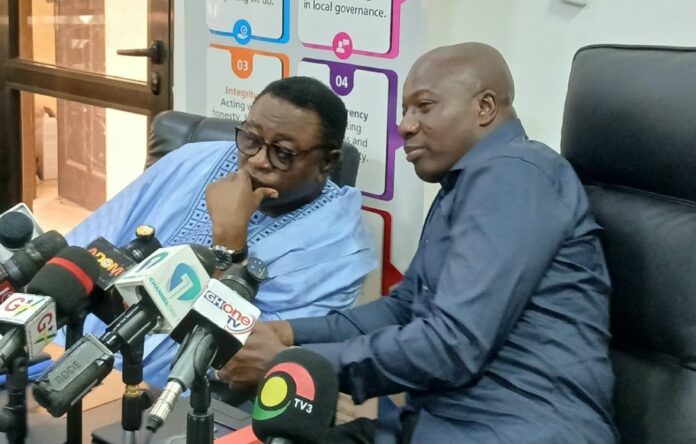

Minister for Local Government, Chieftaincy and Religious Affairs, Mahama Ayariga, has pledged to work closely with religious leaders to protect Ghana’s longstanding tradition of peaceful coexistence among different faith communities.
Ghana’s religious harmony, he said, is an important national inheritance that must be carefully protected and passed on to future generations.
He noted that the presence of representatives from different religious traditions on the committee demonstrated Ghana’s unique ability to bring faith communities together to pray, collaborate, and work for the common good.
Also read: Front Pages: Top newspaper headlines for Wednesday, 9th September, 2026
Mr Ayariga committed on Tuesday, September 8, 2026, when the Committee on Interfaith and Ecumenical Relations led by the Presidential envoy Elvis Afriyie Ankrah, paid a courtesy call on him at his office
“We are blessed with a country where all the religions live peacefully, harmoniously with one another. It’s an inheritance that we must pass on to the generation that will come after us,” he said.
He stressed the need for all stakeholders to guard the peace and religious tolerance enjoyed by the country and do everything possible to prevent developments that could undermine the relationship among Ghana’s various religious groups.
Mr Ayariga assured the Committee on Interfaith and Ecumenical Relations of his readiness to work with its members to strengthen religious harmony and promote national development.
According to him, the ministry would remain open to the advice and guidance of religious leaders, describing the committee as a body with significant experience, expertise and representation across Ghana’s religious communities.
“Our doors will be open 24 hours for your advice, for your guidance,” he said.
Partnership with religious institutions
The minister stressed the longstanding partnership between government and religious institutions, noting that both sides ultimately seek to improve the welfare of citizens.
According to him, religious organisations have made significant contributions to national development through the establishment of schools, hospitals, universities and other institutions that serve communities.
He assured that government would continue to explore ways of pooling its resources with those of religious bodies to improve social services and enhance the wellbeing of Ghanaians.
Help rebuild public trust
Beyond religious harmony, Mr Ayariga identified the restoration of public trust as a major challenge requiring collective action.
He said declining confidence in public institutions could make it difficult for government to mobilise citizens behind important social and economic programmes.
The minister called on the committee to help develop strategies for rebuilding confidence in both government and religious institutions.
“We need to work together to rebuild trust, both at the level of faith and also at the level of secular governance,” he said.
He argued that rebuilding trust would require government to demonstrate integrity, accountability and the capacity to provide practical solutions to problems confronting citizens.
Sanitation
Mr Ayariga disclosed plans to collaborate with religious bodies on sanitation and behavioural change.
He said churches, mosques and other faith-based organisations could play a significant role in changing attitudes towards sanitation because of their influence within communities.
The minister explained that local government institutions must also establish effective systems that enable citizens to participate in keeping their communities clean.
He said working with religious leaders on mindset change could help address sanitation challenges and improve the management of communities across the country.
Support for National Prayers and Thanksgiving Day
Mr Ayariga also expressed his support for efforts to strengthen the National Prayers and Thanksgiving Day programme.
The ministry, he said, is prepared to help build on existing structures to make the annual programme more successful and expand its impact beyond the national level.
He proposed extending the initiative to the regional and district levels, where religious groupings could work together with local institutions to organise similar programmes.
According to him, such initiatives could further demonstrate Ghana’s identity as a peaceful and prayerful nation.
The minister’s pledge comes as the government seeks deeper cooperation with religious leaders on issues including national cohesion, sanitation, social development and the preservation of Ghana’s religious harmony.