

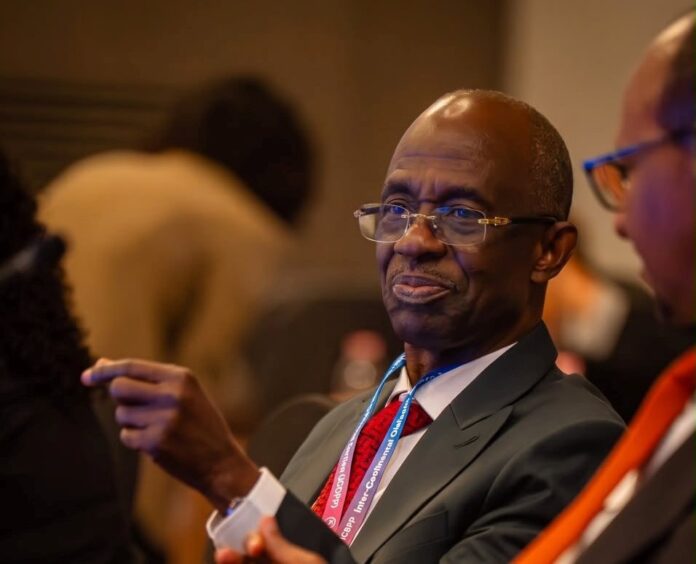

Chairman of the National Democratic Congress (NDC), Johnson Asiedu Nketiah, has called on political parties to rethink how they produce leaders and prepare for government as public trust in political institutions comes under increasing pressure.
Mr Asiedu Nketiah made the call while addressing the inaugural Inter-Continental Dialogue on Political Parties in Seoul, South Korea, on September 7, 2026.
The NDC National Chairman urged political parties to pay closer attention to the quality of leadership they produce, the seriousness with which they prepare for government, and how effectively their politics remain connected to the everyday experiences of citizens.
Also read: Education crisis: Afenyo-Markin demands urgent intervention over WASSCE, BECE
The gathering brought together political parties and representatives from different parts of the world under the African Political Parties Initiative (APPI), with the Africa Governance Centre (AGC), the International Conference of Asian Political Parties (ICAPP) and the Permanent Conference of Political Parties of Latin America and the Caribbean (COPPPAL) involved in the initiative.
He observed that parties that were once sustained by strong historical identities, ideological traditions and generational loyalties can no longer assume that citizens will automatically remain politically committed to them.
According to him, a party’s history may explain its position in national life, but it cannot guarantee its future.
He noted that younger citizens are increasingly exposed to information from across the world and are becoming more demanding in assessing political institutions.
At the same time, many young people face unemployment, economic insecurity, rising living costs and uncertainty over whether education and hard work can still guarantee a better future.
Mr Asiedu Nketiah warned that parties that fail to recognise these changing realities risk losing public trust and the confidence of citizens even when they continue to project political strength.
The NDC National Chairman also stressed the importance of leadership development within political parties.
Drawing on his experience in grassroots politics, Parliament, government and national party organisation, he argued that the character of a future government is often shaped within a political party long before an election is won.
He said the decisions parties make about who advances, the qualities they reward, the seriousness with which they develop policies and the conduct they tolerate can ultimately influence how they govern.
Mr Asiedu Nketiah cautioned political parties against equating electoral success with readiness to govern.
A party may be highly effective at mobilisation, campaigning and winning elections while lacking the institutional, policy and leadership capacity required to manage the complexities of government.
He therefore urged parties to invest in leadership preparation before political opportunities arise and to build institutions strong enough to produce capable leaders beyond the current generation.
Mr Asiedu Nketiah challenged political institutions to examine their failures rather than focusing only on defending their successes.
He said electoral defeats, declining membership, public dissatisfaction and difficult leadership transitions could expose weaknesses that years of political success sometimes conceal.
According to him, parties that are prepared to understand why citizens withdraw their confidence are more likely to renew themselves than those that attribute every setback to the mistakes of their opponents.
He said the Inter-Continental Dialogue provides an opportunity for political parties from different systems to learn from one another.
However, he cautioned that international exchanges should not amount to simply importing political models because political systems are shaped by their individual histories, cultures, institutions and local conditions.
The NDC National Chairman also urged political parties to treat opposition as a period of serious preparation rather than political inactivity.
He said parties in government must maintain their connection with citizens, while opposition parties should go beyond criticism by developing credible alternatives.
According to him, political parties need structures and habits that remain effective whether they are in government or opposition.
Their relevance, he argued, should not depend solely on the authority of government or the temporary weakness of a political opponent, but on their ability to consistently produce ideas, leadership and public confidence.
The inaugural Inter-Continental Dialogue is expected to continue beyond its maiden gathering in South Korea, with future engagements planned in different locations.
Mr Asiedu Nketiah said the initiative should be judged not merely by the visibility of individual meetings but by the quality of relationships developed among participating political institutions.
He argued that political leaders and governments may change, but strong institutional relationships can provide lasting channels for political parties to exchange experiences and learn from one another.
Mr Asiedu Nketiah concluded that political leadership should be assessed beyond individual election cycles.
He said lasting political success should ultimately be measured by the quality of leaders produced, the institutions strengthened and the political culture handed over to future generations.