

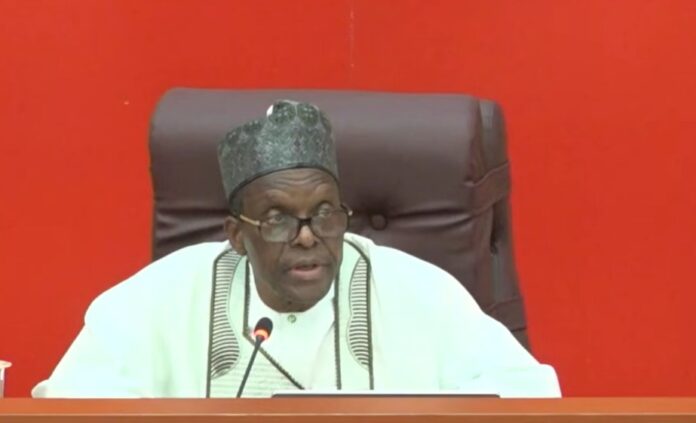

Speaker of Parliament Alban Bagbin has dismissed as inadmissible a private members’ motion seeking to establish an Ad Hoc Committee to investigate major cocaine seizures linked to Ghana, citing the risk of prejudicing ongoing criminal proceedings before the courts.
Ruling on the motion during Parliament’s emergency sitting on Tuesday, September 29, 2026, Bagbin said he had carefully considered the proposed terms of reference, continuing investigations, pending judicial proceedings and the substantial factual overlap between the proposed parliamentary inquiry and matters currently before the courts.
The decision, he said, is also based on Parliament’s constitutional oversight responsibilities, established parliamentary practice and the requirements of the Standing Orders, particularly the provisions governing matters before the courts.
Also read: Armah-Kofi Buah has not resigned from GoldBod – Lands Ministry
According to the Speaker, the proposed parliamentary inquiry went beyond an incidental overlap with the criminal proceedings.
According to him, the committee would have been required to examine evidence, hear witnesses, investigate conduct and assess questions of responsibility that were directly relevant to matters already engaging the criminal justice system.
Mr. Bagbin said such an investigation could require Parliament to determine issues that properly fall within the jurisdiction of the courts.
“The combined effect of undertaking this evaluation, assessment and investigation would, at the end of the day, be to determine the very issues that the court of competent jurisdiction is supposed to determine,” he ruled.
He concluded that allowing the motion to proceed in its present form could prejudice the interests of parties involved in pending judicial proceedings.
The Speaker consequently ruled that the private members’ motion was inadmissible under the relevant provisions of Parliament’s Standing Orders.
“I therefore rule pursuant to Standing Orders 5, 6 and 103 sub-rule F, that the private members’ motion is inadmissible,” he declared.
Mr. Bagbin said Parliament’s oversight responsibilities remained intact despite the dismissal of the motion and explained that MPs could still seek information from ministers, scrutinise the performance of relevant public institutions and examine the adequacy of Ghana’s narcotics-control laws and regulatory framework.
Parliament could also consider broader issues relating to port security, border security and national narcotics policy, he added.
However, Bagbin cautioned that Parliament must avoid conducting a parallel fact-finding exercise that could prejudice people whose cases are currently before the courts.
The Speaker reminded MPs about the definition of a private members’ motion under Parliament’s Standing Orders.
He quoted Order 6, explaining that a private members’ motion is a request by a Member who is not acting in the capacity of a member of parliamentary leadership or a committee of the House, seeking Parliament to take action, order something to be done or express an opinion on a matter of public interest.
Bagbin urged MPs to pay greater attention to the definitions and procedural requirements when submitting parliamentary business.
In his ruling, the Speaker connected the cocaine motion to his earlier remarks about the quality of Ghana’s political discourse.
He said Parliament’s strength is measured not only by the constitutional powers vested in it but also by how those powers were exercised.
Bagbin stressed the need to protect freedom of expression, the right to criticise and the Minority’s constitutional role in holding the Majority to account. At the same time, he said Parliament must protect the dignity of institutions, citizens’ rights and the integrity of the judicial process.
He reiterated that the MPs who requested the emergency sitting had properly exercised their constitutional right under Article 112(3) of the 1992 Constitution.
However, he said the subsequent motion remained subject to Parliament’s Standing Orders on admissibility.
Bagbin ultimately dismissed the motion in limine, citing Standing Orders 5, 6, 103(F), 192 and 233.
The ruling means the proposed Ad Hoc Committee will not proceed in the form presented at Tuesday’s emergency sitting, although Parliament retains its broader constitutional oversight role over Ghana’s narcotics-control regime, port security and border security.
Minority Leader Alexander Afenyo-Markin, however, rejected Speaker Alban Bagbin’s decision to dismiss the motion, insisting that the Speaker “got it wrong.”
According to Afenyo-Markin, the existence of criminal proceedings relating to some of the incidents did not automatically remove Parliament’s constitutional authority to investigate the performance of state institutions.
Speaking to journalists after the Speaker’s ruling, the Minority Leader said Parliament could have conducted the inquiry while taking steps to protect the integrity of ongoing court proceedings.
“Mr. Speaker therefore got it wrong by using existing pending criminal proceedings to determine the scope and manner of the inquiry,” Afenyo-Markin said.
He argued that the proposed ad hoc committee was not intended to prosecute or determine the guilt of any accused person but rather designed to investigate the administration and effectiveness of public institutions involved in narcotics control, customs, border protection, intelligence gathering and port security.
Afenyo-Markin said the proposed committee could have been given clear restrictions to ensure that it did not examine issues directly related to criminal liability.
He said the committee could have been prevented from determining whether an accused person committed an offence, assessing the credibility of prosecution witnesses or ruling on the admissibility of evidence before the courts.
He warned that failure to investigate institutional weaknesses could undermine public confidence and Ghana’s international reputation.
“The image of our country is on trial,” he said.
Afenyo-Markin accused the Majority of using its numerical strength to weaken parliamentary scrutiny, describing the development as a threat to effective oversight.
He nevertheless stated that the Minority would continue to pursue the narcotics issue through constitutional and parliamentary avenues and assured, “We will not let this matter rest.