

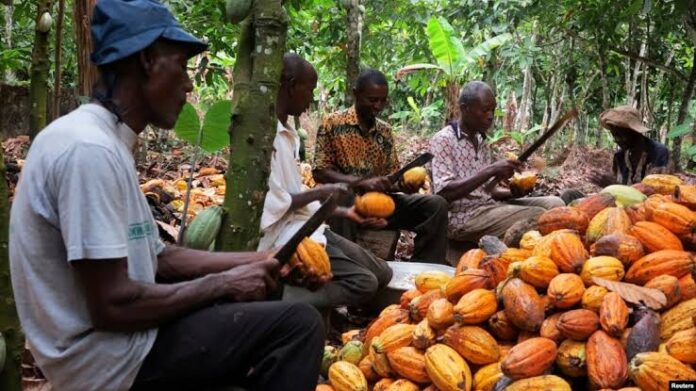

At 6:30 p.m. in Amoako, a farming settlement in the Jasikan District of the OTI Region, Ghana ends. There is no light. No street lamp. No bulb flickers from the homes. The only light is the weak flame of a kerosene ‘bokoben’ lantern and firewood battling the wind. In this total darkness, some of Ghana’s most important wealth is sleeping.
Amoako is a cocoa community. Every household here farms cocoa. From dawn, men, women, and the aged walk miles into the forest to nurse, prune, and harvest the pods that have become Ghana’s economic lifeline. Last year alone, cocoa earned Ghana over $2 billion in foreign exchange. It pays for our roads in Accra, our Free SHS, our hospitals. Yet the people of Amoako who produce this national wealth live without light, without a good road, and without clean drinking water. They carry the nation’s wealth, but they live in darkness.
Also read: Mahama directs GH¢1bn allocation to National Housing Fund in 2027 Budget
THE DARKNESS THAT KILLS DEVELOPMENT
In Amoako, nightfall is not a time to rest; it is a time to fear. Amoako is cut off after 6 p.m. Basic school pupils cannot do their homework. JHS students preparing for BECE huddle around smoky lanterns that burn their eyes and destroy their lungs. At the small community health post, pregnant women are delivered with mobile phone torchlights held between the teeth of birth attendants. The darkness is dangerous. The footpaths linking Amoako to Bodada and Jasikan are bushy. Snake bites are common on evening trips to fetch water. Cases of theft of dried cocoa beans, stored in sheds, rise every season because there is no light to deter thieves. Armed young men take advantage of the blackout to attack farmers returning from market. And this darkness is directly killing cocoa production.
Cocoa farming is time-sensitive. Fermentation must be turned; drying must be monitored. Without light, quality control stops at 6 p.m. If it rains at night, no one can save the drying beans. More importantly, our youth are leaving. Which young man wants to stay in Amoako where he cannot charge his phone, watch the Black Stars, or listen to news? They migrate to Accra and Hohoe to ride okada, leaving cocoa farms to ageing grandparents. Who will farm cocoa in OTI in the next ten years if Amoako remains in darkness?
NO ROAD, NO WATER, NO LIFE
Add to the darkness, two other killers.
The Road: The road from Jasikan to Amoako is unmotorable, especially from May to October. During peak cocoa season, farmers carry 64kg bags on their heads for over 7 kilometers to the main Jasikan-Bodada road before a vehicle will pick them. Many buyers refuse to come at all. The beans absorb moisture, develop mold, and are downgraded. The farmer’s profit is lost to the head-porter and to poor quality.
The Water: Amoako has no potable water. The entire community depends on a single stream – the same stream used for washing, for animals, and for drinking. Typhoid, bilharzia and chronic diarrhoea are normal here. A farmer who should be on his farm spraying his cocoa spends two weeks treating water-borne disease. How can productivity increase?
The standard of living is below the poverty line, yet these are the very people keeping Ghana’s economy afloat.
A CALL TO ACTION
This is not a cry for alms. It is a demand for equity. A fraction of the wealth from Amoako’s cocoa should return to Amoako.
1. To Government and COCOBOD: Jasikan is a major cocoa district in OTI. It deserves priority. We appeal to the Ministry of Energy and the Rural Electrification Authority to extend the national grid to Amoako or provide a solar mini-grid. COCOBOD must see rural lighting as a productivity tool, not charity. Its Cocoa Roads programme must be felt here – the 7km Amoako feeder road is not a luxury; it is an economic investment that will pay for itself.
2. To the Oti Regional Coordinating Council and Jasikan District Assembly: Amoako should be on top of the District Development Facility priority list for a mechanized borehole and a solar-powered CHPS compound that can work at night.
3. To NGOs, LBCs and Corporate Bodies: We call on NGOs in WASH, on Licensed Buying Companies like PBC, Kuapa Kookoo, Olam, and Federated Commodities who buy our cocoa, to invest their Fairtrade premiums into real light and water for Amoako. A solar phone-charging centre by a telco could keep the youth here.
The chiefs and people of Amoako have sacrificed enough. They have toiled for Ghana. Ghana must not continue to take the cocoa and leave the farmer in the dark. If we light Amoako, we secure cocoa. If we give Amoako water and roads, we give dignity back to those who carry the nation’s wealth.
Let there be light in Amoako, for the sake of Ghana’s future.
By Dr. Francis Kwadzo Agbenyegah
Lecturer at Ghana Communication Technology University (GCTU).