

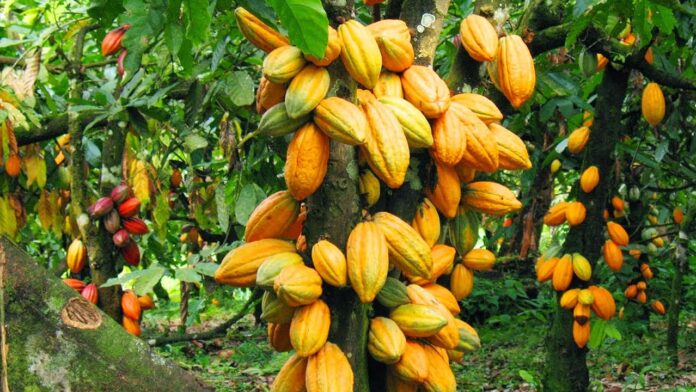

The Ghana Cocoa Board (COCOBOD) has issued and listed its highest-ever cedi-denominated instrument on the Ghana Stock Exchange (GSE) to raise GH¢16.30 billion to fund cocoa purchases.
The Domestic Cocoa Notes Programme comprises GH¢14 billion in commercial paper and a GH¢2.30 billion bond to fund cocoa purchases beyond the 2026/2027 crop season.
The bond and note issued through COCOBOD’s subsidiary, the Cocoa Capital PLC, a wholly owned financing vehicle of the board, are open to all Ghanaians, especially institutional investors, in a major move to take control of financing cocoa purchases, while curtailing the age-old reliance on syndicated loans from international banks and financial institutions.
The listing ceremony on the GSE yesterday marks a shift towards mobilising domestic capital to finance cocoa purchases and reduce reliance on external borrowing.
Also read: Ato Forson predicts Ghana will beat IMF’s 5.7% growth forecast
The inaugural issuance attracted approximately GH¢3.59 billion in investor bids at an interest rate of 11 per cent per annum.
The event brought together COCOBOD management, the board of Cocoa Capital PLC, SEC, representatives of banking partners, advisors, and institutional investors.
Abena Amoah (2nd from left), MD of GSE, presenting a memento to John Awuah, Board Chairman, Cocoa Capital PLC, for the successful listing. With them includes Dr Randy Abbey (2nd from right), Chief Executive, COCOBOD
Cocoa financing evolution
The Chief Executive of COCOBOD, Dr Randy Anertey Abbey, described the initiative as a defining moment in the evolution of Ghana’s cocoa financing framework, saying the new model would broaden the board’s financing options, mobilise domestic resources and establish a strong connection between Ghana’s fixed income market and the cocoa industry.
Historically, the purchase of cocoa beans, the mainstay of Ghana’s economy, has been financed through foreign banks, with minimal exposure by indigenous banks. Previously, it used to be funded from budgetary allocations.
The latest funding model, financial analysts maintain, would make the country self-reliant in funding its cocoa purchases, prevent capital flight and preserve value within the country.
“This is the first of its kind: a new model of cocoa financing that is not based on government budget allocation, an offshore syndicated loan or buyer pre-finance. For almost a century, cocoa trade in Ghana has been financed through these different models,” Dr Abbey said.
He explained that the Domestic Cocoa Notes Programme represented a deliberate transition towards a cedi-denominated financing model that mobilised domestic liquidity, reduced reliance on offshore borrowing and established a stronger connection between Ghana’s capital market and one of the country’s most important productive sectors.
“This transition is more than replacing one source of funding with another.
It is about taking advantage of the macroeconomic environment, the domestic capital market, broadening COCOBOD’s financing options, diversifying funding risk and establishing a flexible platform capable of responding to the seasonal and long-term requirements of the cocoa industry,” Dr Abbey added.
The COCOBOD boss disclosed that the proceeds of the first series would be applied to provide working-capital support for cocoa purchases during the 2026/27 crop season, ensuring that adequate funding is available to purchase cocoa beans throughout the year.
“The success of this financing supports our broader commitment to safeguarding farmer incomes, ensuring timely payments and placing the cocoa industry on a more sustainable financial footing. Therefore, the cocoa farmer is at the heart of this transaction,” he emphasised.
Dr Abbey assured investors that the funds raised through the programme would be applied strictly to the intended purpose — the purchase of cocoa and the core operations of COCOBOD — grounded in the new COCOBOD Act, 2026, which mandates the board to focus on its core functions.
“Besides the DDEP Cocoa Bonds, the proceeds of the issuance will not, and cannot, be used to pay other legacy debts of COCOBOD,” he stated.
Fidelity
Dr Abbey expressed appreciation to the banks, pension funds, fund managers and other institutional investors that participated in the inaugural series, saying their participation demonstrated that Ghanaian institutional investors were prepared to support well-structured, transparent and commercially sound financing solutions.
He extended an open invitation to investors who could not participate in the maiden issuance to engage with Cocoa Capital PLC, COCOBOD and the transaction team, undertake the necessary credit assessment and participate in subsequent issuances.
The COCOBOD Chief Executive also acknowledged the contribution of several institutions and individuals who made the transaction possible, including the Ministry of Finance, the Bank of Ghana, the Securities and Exchange Commission, the GSE, the Central Securities Depository, SEM Capital, the Transaction Adviser, the Joint Lead Managers and Bookrunners — Absa Bank Ghana LTD, CalBank PLC, Fincap Securities Ltd, GCB Bank PLC, One Africa Securities LTD, and Stanbic Bank Ghana LTD — as well as Sory@Law, KPMG, PwC, Beacon Ratings, the Board of Cocoa Capital PLC and the management and staff of COCOBOD.
Dr Abbey described the achievement as the beginning of COCOBOD’s responsibility to manage the programme with discipline, transparency and accountability, pledging that the board would continue to engage openly with investors, comply with all reporting requirements, meet its debt-service obligations and demonstrate through its conduct that Ghana’s cocoa sector remains a credible destination for domestic institutional capital.
“The success of this first series gives us confidence that Ghana can build a sustainable domestic financing platform for cocoa. It also reminds us that the long-term strength of the platform will depend on our continued commitment to sound financial management, effective governance and the productive use of the funds entrusted to us,” Dr Abbey added.
Beyond raising funds
The Board Chairman of Cocoa Capital PLC, John Awuah, said the initiative, which was a Special Purpose Vehicle (SPV), went beyond raising funds for the immediate cocoa purchasing season, explaining that the SPV had been established to provide a structured financing mechanism capable of addressing the sector’s funding requirements, while maintaining transparency and accountability.
He stressed that the success of the programme would depend on disciplined execution and the ability to meet financial obligations.
The President of the Ghana Association of Banks, Kwamina Asomaning, also highlighted the importance of collaboration among banks, capital markets and domestic investors in financing productive sectors of the economy.
Mr Asomaning, who is also the Chief Executive of Stanbic Bank Ghana, stated that timely financing would support cocoa purchases and strengthen the link between domestic savings and local economic activity.
The Managing Director of GSE, Abena Amoah, welcomed the transaction as an example of how the domestic capital market could mobilise resources for national development.
Graphic online