

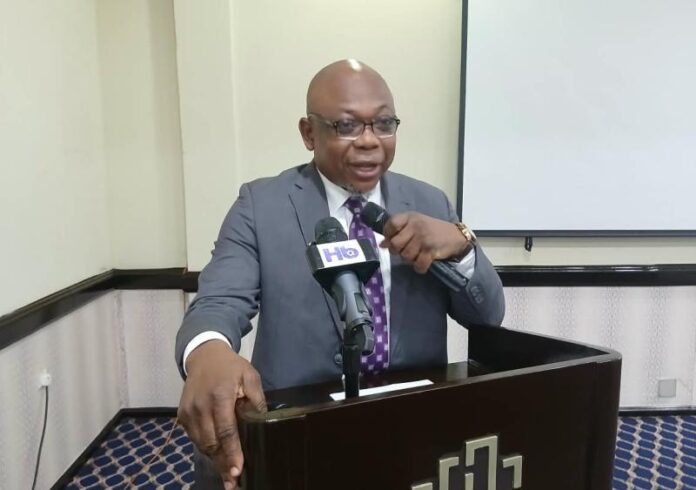

Majority Leader James Agalga has cautioned journalists against publishing confidential parliamentary proceedings and embargoed documents, warning that unauthorised disclosures could expose them to contempt proceedings.
Members of the Parliamentary Press Corps, he said, must exercise extreme caution when reporting on committee hearings held in camera, privileged information and matters pending before the courts, stressing that professional journalism requires respect for established parliamentary rules and legal procedures.
Speaking at a workshop for members of the Parliamentary Press Corps in Accra on Thursday, October 15, 2026, Mr Agalga charged journalists to understand the potential legal consequences of publishing information that is restricted from public disclosure.
Also read: Front Pages: Top newspaper headlines for Friday, 16th October 2026
He explained that confidential Parliamentary proceedings, including matters before the courts, require particular care because reporting that prejudiced ongoing proceedings could attract legal sanctions.
“Matters before the courts, privileged information, and confidential committee proceedings call for care,” he said.
Mr Agalga urged the Press Corps to respect the rules governing in-camera sessions and embargoed documents, warning that unauthorised publication of confidential material could undermine Parliament’s integrity and expose reporters to legal risks.
“When matters are embargoed, committee hearings are conducted in-camera. And you chance upon material from the in-camera proceedings and decide to publish, you open yourself up for contempt of Parliament,” he stated.
The Majority Leader added that Parliament has powers to cite individuals for contempt, just as the courts could sanction conduct that interferes with the administration of justice.
His remarks were delivered under the theme, Enhancing the Image of Parliament Through the Media: Expectations of the Majority Caucus.
Beyond confidential Parliamentary proceedings, Mr Agalga called on journalists to uphold accuracy, fairness, balance and independence in their coverage of parliamentary proceedings.
He urged reporters to verify information before publication by consulting official records, including the Order Paper and Votes and Proceedings, and seeking clarification from the appropriate parliamentary offices.
“We would rather answer 10 questions than correct one false headline,” he said.
He also cautioned journalists against confusing the various stages of legislative business, explaining that a bill that has received a second reading has not necessarily been passed, while committee recommendations require adoption by the House before becoming its decision.
According to him, a better understanding of parliamentary procedures would help prevent inaccurate reports and improve public understanding of the legislature.
Mr Agalga urged the press corps to give greater attention to committee work, legislative scrutiny, public hearings and constituency issues rather than focus mainly on political confrontations in the chamber.
Despite his caution on confidential proceedings, Mr Agalga reaffirmed the Majority Caucus’s commitment to press freedom and accountability.
Parliamentary leaders and members, he said, would work to improve journalists’ access to proceedings, provide timely information and make themselves available for interviews, including on difficult questions.
“In a constitutional democracy, free press is not a nuisance to be managed, but a pillar to be protected,” he said.
He added that the Majority Caucus would not treat critical reporting as hostility and would welcome fact-based scrutiny.
He acknowledged that some public criticism of Parliament is justified, particularly concerns about absenteeism, partisan confrontations and the effectiveness of legislative oversight.
He pledged that the caucus would work to improve attendance, conduct in the chamber, and engagement with parliamentary business.
Mr Agalga also proposed regular engagements between parliamentary leadership and journalists, continuous training on legislative procedures and improved communication channels for fact-checking and clarification.
He said cooperation between Parliament and the media is essential to strengthening public confidence in the legislature and Ghana’s democratic institutions.