

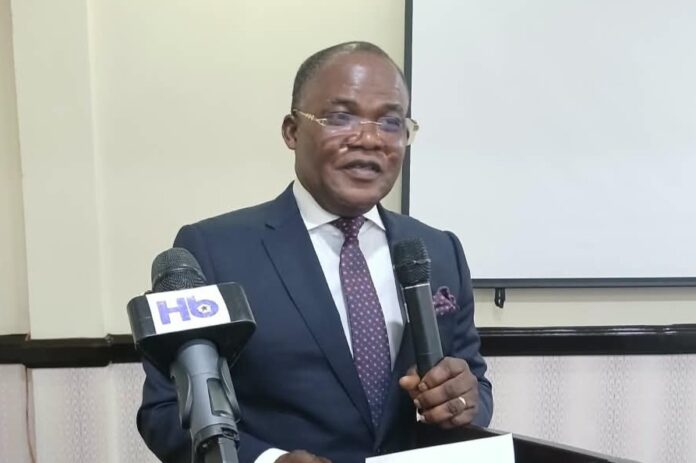

The Clerk to Parliament, Ebenezer Ahomah Djietror, has called for an urgent upgrade of Parliament’s infrastructure, citing inadequate office space, meeting rooms and committee facilities that constrain legislative work and parliamentary reporting.
Mr Djietror explained that the shortage of meeting facilities creates practical difficulties for parliamentary caucuses and committees, particularly when large numbers of lawmakers and government officials need to meet.
Addressing a two-day workshop for members of the Parliamentary Press Corps in Accra on Thursday, October 15, 2026, Mr Djietror said the existing facilities and Chamber are insufficient to support the growing demands of parliamentary business.
Also read: Majority Leader warns journalists against publishing confidential Parliamentary proceedings
He called for investment in adequate workspaces, meeting areas, division rooms and designated lobbies to facilitate engagements among Members of Parliament, ministers and parliamentary caucuses.
“It is for these reasons that we need to look critically at the infrastructure development,” he said.
Committees, he said, require adequate space to scrutinise the operations and expenditure of ministries, departments and agencies (MDAs), noting that officials appearing before committees often included chief executives, deputies and representatives from legal, finance, budget and audit departments.
“Look at our workspace. Then the committee, members of the committee. Look at the workspace. You can see that there’s a practical problem,” he said.
Mr. Djietror argued that improved infrastructure is necessary to enable Parliament to discharge its legislative and oversight responsibilities effectively.
The Clerk also stressed the impact of inadequate facilities on parliamentary correspondents, warning that a lack of suitable working space could delay news publication and limit timely public access to information.
He dismissed the perception that journalists covering Parliament spend only a few hours at the House, stressing that their work often require extended periods of coverage.
“Sometimes you are here for 16 hours. 12 hours,” he stressed.
According to him, journalists need appropriate facilities to process information and report promptly on parliamentary proceedings.
“If you have no workspace, you have to travel to your office before you do the reporting. Sometimes the news may come late,” he said.
He urged journalists to report responsibly on the challenges facing Parliament to help the public understand the need for improved facilities.
Beyond infrastructure, Mr Djietror emphasised the media’s role in promoting democratic governance, describing journalists as essential partners in communicating Parliament’s work to citizens.
“The media is an indispensable partner in democratic government,” he said.
According to him, accurate and balanced reporting helps citizens understand legislative decisions, government policies and the conduct of elected officials.
The Clerk also urged parliamentary reporters to maintain professional integrity and objectivity in their coverage of the Majority and Minority caucuses.
“You may have friends on either side of the House, but make sure in the discharge of your duties, you are guided, properly guided,” he said.
He cautioned against reporting practices that unnecessarily intensify political disagreements, urging journalists to focus on informing the public and clarifying issues.
“Your role as a media is not to create confusion, but to better elucidate,” he said.
Mr Djietror encouraged the Parliamentary Press Corps to continue performing its duties diligently, stressing that improved parliamentary infrastructure and responsible journalism would strengthen public understanding and democratic accountability.