

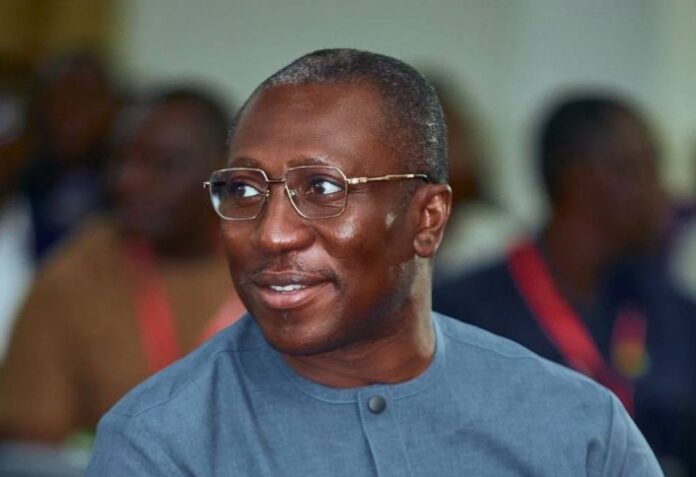

Minority Leader Alexander Afenyo-Markin has challenged African parliaments to move beyond identifying financial irregularities in public institutions and ensure that officials responsible for financial misconduct face appropriate sanctions.
He warned that repeatedly uncovering financial infractions through audit reports without securing corrective action, recovering misappropriated public funds, or punishing wrongdoing undermines public confidence in accountability institutions.
Speaking at the African Organization of Public Accounts Committees (AFROPAC) conference and general meeting in Accra on Monday, November 2, 2026, Afenyo-Markin said African countries could no longer afford to audit the same financial irregularities year after year without holding anyone accountable.
“Africa cannot continue to audit the same failures year after year without holding anyone accountable,” he declared.
The conference is being held under the theme, “Oversight for Resilience: Strengthening Africa’s Public Accounts Committees Amid a Shifting Financial Landscape.”
The Minority Leader said the effectiveness of Public Accounts Committees (PACs) should not be measured by the number of public officials summoned, audit queries examined or parliamentary hearings conducted, but by the corrective measures that follow.
He observed that audit reports across the continent continue to expose irregular expenditures, unsupported payments, procurement weaknesses, revenue collection failures and deficiencies in the management of public assets.
Although parliamentary committees regularly examine these findings, summon public officials and make recommendations, he questioned whether the necessary actions are taken after the hearings have ended.
Afenyo-Markin asked whether irregularities are corrected, public funds recovered, responsible officials sanctioned, and institutional weaknesses that facilitate financial misconduct addressed.
He maintained that accountability must produce measurable results rather than remain an exercise in parliamentary appearances and public declarations.
According to him, the need for stronger public financial accountability has become more urgent as African countries grapple with economic shocks, rising debt obligations, inflationary pressures and shrinking fiscal space.
Governments, he said, are operating under increasing financial constraints while citizens continue to demand better healthcare, quality education, modern infrastructure and improved economic opportunities.
He noted that the consequences of weak financial accountability extend beyond figures contained in audit reports, often manifesting in hospitals without essential equipment, schools lacking adequate infrastructure, abandoned roads and communities deprived of public services.
Afenyo-Markin called for stronger institutional mechanisms to ensure that audit recommendations are implemented and public resources are protected.
He argued that African parliaments must strengthen their capacity not only to identify financial irregularities but also to prevent misconduct, pursue corrective action and secure the recovery of public funds.
He urged delegates to use the AFROPAC platform to exchange experiences and develop practical approaches to monitoring the implementation of audit recommendations.
The Minority Leader also stressed that public financial accountability must remain a consistent obligation regardless of which political party controls government.
He said the responsibility to protect the public purse must not be defended only by political parties in opposition and conveniently disregarded when they assume power.
Afenyo-Markin called on both parliamentary majorities and minorities to exercise their oversight responsibilities with diligence, fairness and commitment to constitutional principles.
He stressed that the strength of African parliaments would ultimately be determined not merely by the number of laws they pass, but by their vigilance in ensuring that public resources are properly utilised for the benefit of citizens.