


The Minority in Parliament has accused the government of lacking a clear, consistent strategy for its proposed $10 billion New Economy programme, citing repeated changes to its financial projections, implementation timelines, and priority sectors.
Kojo Oppong Nkrumah, Ranking Member of Parliament for the Economy and Development Committee, said the government presented conflicting descriptions of the programme within five months, raising questions about its planning, policy direction, and credibility.
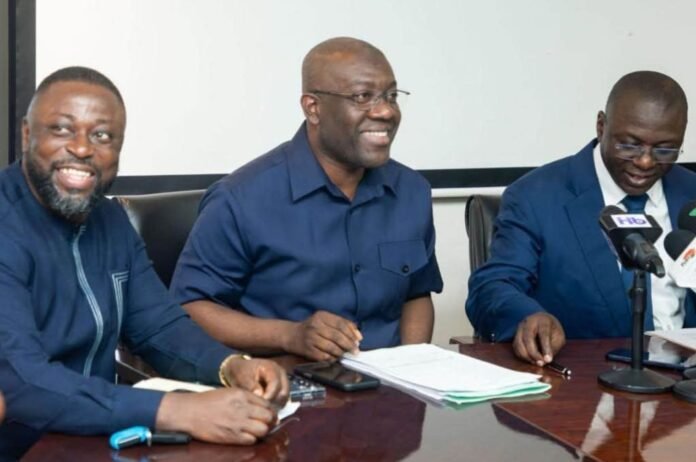
Addressing journalists at the Minority’s press conference on the 2027 Budget on Friday, Oppong Nkrumah said the programme, which was initially introduced in June 2026, had undergone several changes in scope and projected funding.
Also read: Exercises that help lower blood sugar
He traced the first announcement to the Finance Minister at the Ghana-UK Investment Summit in June, where four priority sectors were identified: commercial agriculture, the mining value chain, energy and transport infrastructure.
According to him, however, President Mahama subsequently announced on August 14, during his Resetting Ghana tour in Navrongo, that the programme would be a $10 billion investment over four years, equivalent to $2.5 billion annually, with seven priority sectors.
He claimed that the programme’s description changed again in September when Deputy Finance Minister Thomas Nyarko Ampem presented six sectors, while President Mahama later reduced the number to five during an accountability engagement in Wa.
He further cited a September 17 engagement with Ahafo chiefs at Jubilee House, where the President reportedly revised the annual investment projection to $2 billion and expanded the priority sectors to nine.
The Ranking Member said the Finance Minister subsequently reduced the projected annual investment to $1.6 billion during a September 27 meeting with the Association of Ghana Industries (AGI).
He added that the figure changed again in October when President Mahama announced a $2 billion annual investment over four years during the sod-cutting ceremony for the Afienya Industrial Park, before returning to a $10 billion projection spread over five years in another announcement.
Oppong Nkrumah argued that the frequent revisions suggested the government is still struggling to establish a coherent framework for the programme.
“They make it up as they go along,” he declared.
He said the inconsistencies extended beyond the programme’s financial commitments to the number of sectors and pillars under which the New Economy agenda is being implemented.
According to him, the programme had variously been presented as having five, six, seven and nine sectors, with different funding projections and implementation periods.
The Minority member linked the alleged inconsistencies to what he described as the government’s failure to account adequately for previous development promises and expenditure commitments.
He questioned the credibility of the new programme, citing commitments on job creation, the 24-hour Economy, the proposed Women’s Development Bank, oil palm development and the construction of Agenda 111 hospitals.
Oppong Nkrumah challenged the government to account for its previous promise to create 800,000 jobs within its first two years, arguing that Ghanaians deserved evidence of delivery before being asked to embrace another economic transformation programme.
He challenged the government to provide greater clarity on the objectives, financing arrangements, priority sectors and implementation framework of the New Economy programme.