

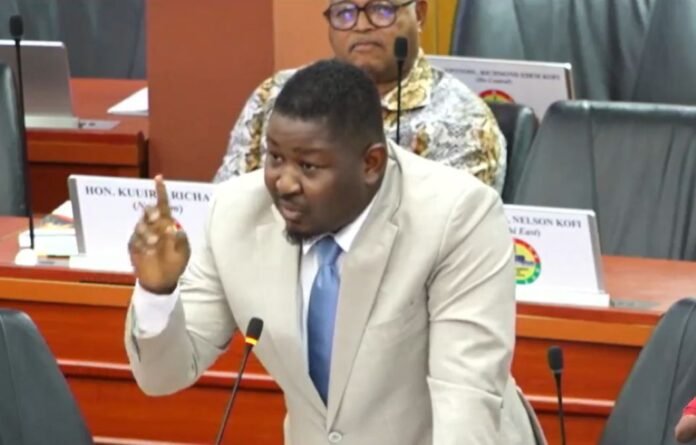

Member of Parliament for Sagnarigu and Finance Committee member Hon. Atta Issah has called for an end to political sloganeering in Ghana’s economic management, taking a sharp swipe at the ‘fanciful names’ given to national budgets over the past decade.
Contributing to the parliamentary debate on the 2027 Budget Statement and Economic Policy, the National Democratic Congress (NDC) lawmaker argued that national fiscal plans must be judged by measurable macroeconomic assumptions rather than catchy branding.
“Mr. Speaker, as a country, over the last 10 budget cycles, we were used to budget fanciful names like ‘Asempa Budget’, ‘Adjinkwa Budget ‘, ‘Nkunim Budget ‘, and many other fanciful names.”
“Yet they landed this country and 2.5 of our people in the multi-poverty dimension index report,” Issah stated. He signaled a deliberate shift away from past political marketing toward strict fiscal accountability.
Also read: GH¢680m judgment debt bomb hits GRA; Patrick Boamah exposes Safaritech liability.
To back his call for data-driven scrutiny, the Finance Committee member traced Ghana’s economic trajectory under the $3 billion International Monetary Fund (IMF) Extended Credit Facility (ECF) signed by former Finance Minister Dr. Mohammed Amin Adam for the 2023–2026 period.
He noted that the previous administration committed the country to strict quantitative performance metrics and structural benchmarks centered on three core goals: restoring macroeconomic stability, ensuring debt sustainability, and laying the foundation for inclusive growth.
According to Issah, the 2025 budget was specifically engineered to correct the ‘slippages of 2024’ and restore order. He stressed the foundational assumptions that underpinned the 2025 fiscal plan – including fiscal consolidation, inflation reduction, exchange rate stability, and revenue mobilization – insisting that all structural benchmarks are successfully met.
Moving into 2026, he explained, the government shifted gears from pure consolidation to stability and growth. By maintaining fiscal discipline, tightening monetary policy, and prioritizing growth-enhancing public investments, the 2026 budget also achieved its IMF-aligned targets.
Framing the 2025 and 2026 budgets as the heavy lifting required to steady the ship, the Sagnarigu MP defended Finance Minister Dr. Cassiel Ato Forson’s 2027 budget as the gateway to a ‘new economy’.
“There is nowhere in the world that an economy can create sustainable jobs without first of all stabilizing the economy.”
“Macroeconomic stability is the strong foundation on which private sector investment, sustainable job creation, and economic growth are anchored,” Issah told the House.
He outlined seven core assumptions driving the 2027 fiscal blueprint:
• Preserving current macroeconomic stability
• Increasing fiscal space
• Expanding productive capacity
• Boosting private sector financing and revenue efficiency
• Accelerating foreign reserve accumulation
• Driving export diversification
• Stimulating employment and income growth
He argued that by stripping away ornate budget titles and anchoring the 2027 policy document to concrete indicators, the Majority side is attempting to frame its economic stewardship as serious and results-oriented.