

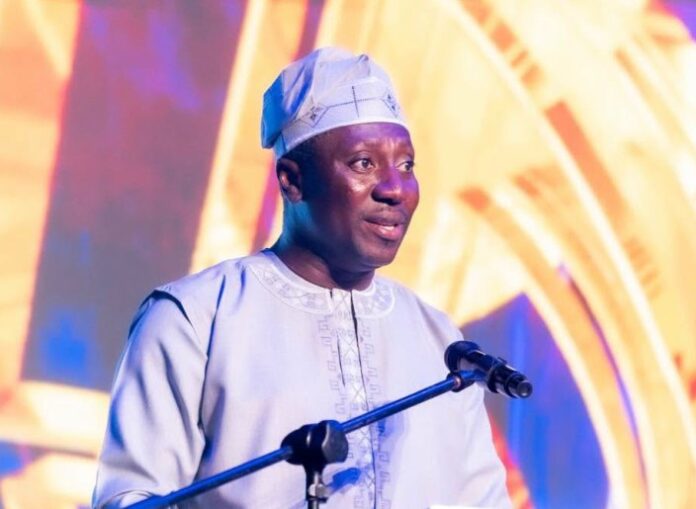

Minority Leader Alexander Afenyo-Markin has warned against what he describes as a growing culture of criminalising free speech in Ghana, insisting that the country must not return to an era when journalists and citizens face prosecution for expressing dissenting views.
The Minority Caucus, he said, is sponsoring a Bill to repeal Section 208 of the Criminal Offences Act, which deals with the publication of false news likely to cause fear and alarm to the public.
Addressing the 30th Ghana Journalists Association (GJA) Media Awards, Mr Afenyo-Markin said the increasing use of the provision against citizens and journalists threatens Ghana’s democratic credentials and could undermine the gains made in press freedom since the repeal of criminal libel laws in 2001.
Also read: Auditor-General reveals GH¢1bn unpaid taxes by 10 SOEs, challenges Parliament to act
Speaking under the theme, “Celebrating excellence, advancing media freedom and combating hate speech in the digital age,” the Minority Leader argued that democracy cannot thrive where journalists are intimidated for investigating public officials, or citizens are afraid to criticise those in authority.
“A democracy is not measured only by the number of radio stations, newspapers, television channels and social-media accounts it has. A democracy is measured by whether a citizen can speak without fear; whether a journalist can investigate without intimidation,” he said.
Mr Afenyo-Markin expressed concern about what he described as the growing use of the so-called fear and panic provision under Section 208 of the Criminal Offences Act to prosecute citizens and journalists over their publications and expressions.
He cited concerns raised by the Media Foundation for West Africa about what it calls a “creeping criminalisation of speech” in Ghana, including arrests and prosecutions under Section 208 and related provisions.
The Minority Leader also referred to a legal challenge before the Supreme Court questioning the constitutionality of the provision, arguing that its continued application is inconsistent with the freedoms of speech, expression and the press guaranteed under the Constitution.
“Our caucus takes the view that Section 208 has no place in Ghana’s democracy. Its use to prosecute citizens and journalists for what they say or publish is fundamentally at odds with the freedoms of speech and of the press that our Constitution guarantees,” he stated.
He indicated that the Minority will also pursue the repeal of Section 76 of the Electronic Communications Act, 2008, arguing that the provision has also been used alongside Section 208 to criminalise online expression.
Mr Afenyo-Markin, however, stressed that the Minority’s position should not be interpreted as support for irresponsible journalism, hate speech or publications intended to incite violence.
According to him, freedom of expression must be exercised with responsibility, but he maintained that civil remedies, rather than criminal prosecution, should be the appropriate response to defamation and false publications.
“We do not defend lies. We do not defend hate speech. We do not defend incitement. We do not defend reckless publications that destroy reputations, endanger lives, or undermine public peace,” he said.
He argued that individuals whose reputations are damaged by false publications can seek redress through civil actions, including retractions, apologies and compensation.
“What should not happen is that disagreement, criticism, satire, political comment, or even an honest mistake should become the basis for criminal prosecution and imprisonment,” he added.
The Minority leader also warned against the use of Strategic Lawsuits Against Public Participation (SLAPPs) to intimidate journalists, editors and citizens who expose wrongdoing or criticise powerful individuals.
Wealthy and influential people, he said, should not be allowed to exploit the judicial system through expensive and burdensome lawsuits intended to exhaust media organisations financially and silence public criticism.
“We will not accept a system in which the wealthy and powerful use burdensome lawsuits, not to protect their reputations, but to bankrupt journalists, exhaust editors, and frighten citizens into silence,” he declared.
He insisted that justice must not become an instrument of intimidation against journalists and other citizens exercising their constitutional rights.
The Minority Leader invoked the democratic legacies of former Presidents Kofi Abrefa Busia, John Agyekum Kufuor and Nana Addo Dankwa Akufo-Addo, recalling Dr Busia’s 1965 warning about the importance of freedom of speech, association and movement, arguing that development without liberty is incomplete.
He also cited former President Kufuor’s decision in 2001 to repeal Ghana’s criminal libel and seditious laws, describing the move as a major milestone in the country’s democratic development, and Akufo-Addo’s 2021 declaration that he would rather have a reckless press than a supine one.
According to him, the democratic gains achieved through the repeal of criminal libel must not be undermined by the use of other criminal provisions against journalists and citizens.
“The Minority will continue to defend the right of every Ghanaian to speak, question, criticise, publish and disagree because freedom of speech belongs not to one party, one profession, or one class of people. It belongs to all Ghanaians,” he said.