

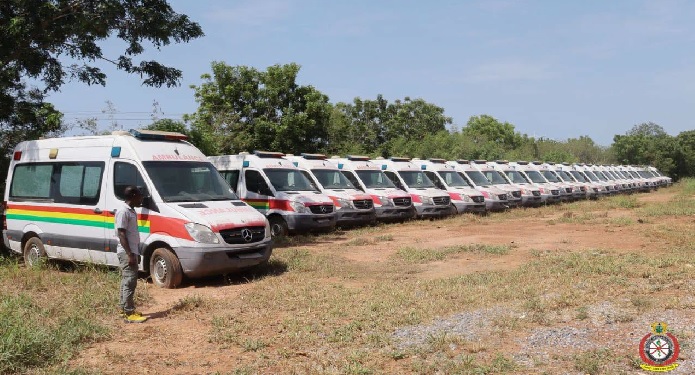

Health Minister Kwabena Mintah Akandoh has disclosed that the government inherited an ambulance fleet with none of the vehicles insured, and that many ambulances were also grounded.
According to the Minister, the condition of the national ambulance fleet was among the major challenges encountered by the government after assuming office.
Speaking on Joy News’ PM Express on Wednesday, Mr Akandoh said the government discovered that the country’s ambulances were operating without insurance cover.
Also read: Front Pages: Top newspaper headlines for Thursday, 8th October 2026
He explained that the government then took steps to close the insurance gap, ensuring all ambulances were insured in 2025.
Mr Akandoh responded to concerns about the availability and condition of ambulances across the country, acknowledging that several vehicles were grounded when the government took office.
“I get this feedback that we don’t have ambulances, and all our ambulances have been grounded, and all that,” he said.
The Minister confirmed that there were indeed a large number of grounded ambulances at the time the government assumed office.
“When we took office, there were a lot of them that were grounded. But as I speak to you now, we have more than 200 ambulances functioning,” Mr Akandoh said.
The disclosure comes amid continuing public concerns about emergency medical transportation and the availability of ambulances, particularly in areas where residents face difficulties accessing timely emergency services.
Mr Akandoh announced that the government intends to expand and replenish the national ambulance fleet with the acquisition of 100 new vehicles in 2027.
The planned acquisition is expected to strengthen the country’s emergency response capacity and replace ambulances that have become obsolete or are no longer fit for service.
The Minister, however, said the government has not yet decided how the new ambulances will be distributed across the country.
Mr Akandoh was asked whether the government would continue with the previous administration’s “One Constituency, One Ambulance” approach in distributing the new vehicles.
He said no final decision had been taken on the matter.
“Well, we have not taken the decision yet,” he said.
The Health Minister suggested that priority could instead be given to areas where existing ambulances have broken down or become non-functional.
“But I believe that if you have an ambulance within a particular area, and that ambulance is faulty, or is no longer functional, it’s only fair to replace that ambulance,” he explained.
He said the government is also assessing the strengths and weaknesses of the previous distribution model before deciding whether to retain or modify it.
“But then we think about what they did, the pros and cons; we’ve tried that system — can we continue, or do we have to review it as a country?” Mr Akandoh said.
He stressed that the government would not necessarily discard existing systems simply because they were introduced by a previous administration.
“We can only build on that as a system, and governance is a continuum. If we think that that system has served us well, why do we have to revamp?” the Minister added.
The planned addition of 100 new ambulances in 2027, together with efforts to keep the existing fleet operational and insured, is expected to form part of the government’s broader efforts to improve emergency healthcare delivery across Ghana.