


The government has unveiled an ambitious US$10 billion economic transformation programme, committing GH¢30 billion to its implementation in 2027 as part of efforts to create jobs, expand domestic production and accelerate Ghana’s industrialisation.
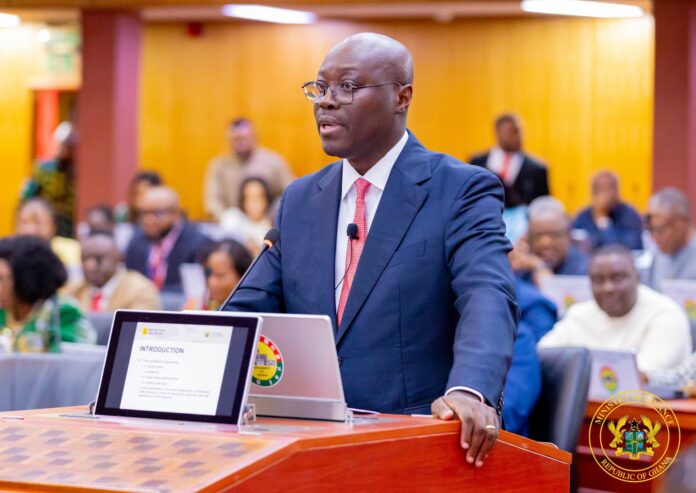
Finance Minister Dr Cassiel Ato Forson announced the initiative, dubbed New Economy, New Ghana: Jobs and Prosperity, when he presented the 2027 Budget Statement and Economic Policy to Parliament on Thursday, November 12, 2026.
The four-year programme, covering 2027 to 2030, will focus on eight strategic areas, including commercial agriculture, energy infrastructure, mineral value addition, tourism, culture and creative arts, textiles and garments, pharmaceuticals and biomanufacturing, and the technology economy.
Also read: Live: Finance Minister Dr Ato Forson presents 2027 Budget to Parliament
The government has allocated GH¢30 billion, representing 1.5 per cent of Gross Domestic Product (GDP), to the programme in 2027, with the overall investment expected to reach the equivalent of US$10 billion over the four years.
Dr Forson said the initiative is designed to address structural weaknesses in Ghana’s economy, particularly its dependence on raw material exports, limited domestic processing capacity and inadequate industrial expansion.
He explained that the investment would be directed towards productive infrastructure, businesses and industries capable of creating sustainable employment, increasing exports and strengthening the country’s economic resilience.
A major component of the US$10 billion New Economy programme is a US$3 billion investment in commercial agriculture, aimed at increasing food production, reducing imports and strengthening the connection between agriculture and industry.
Dr Forson said agriculture contributes approximately 20 per cent of Ghana’s GDP, nearly 40 per cent of employment and about 25 per cent of export earnings.
Despite its importance, he observed that Ghana continues to spend billions of dollars annually importing agricultural products that could be produced competitively within the country.
The government’s agricultural intervention will target rice, sugar, poultry, maize, soya, animal feed, aquaculture, oil palm, vegetables and cocoa value addition.
Under the initiative, the government will establish an integrated farm-to-market system connecting farmers to irrigation facilities, improved seeds, mechanisation, storage infrastructure, processing factories, packaging, transportation and markets.
The programme will also establish rice development hubs across the Volta Basin, Western Ghana, Northern Ghana and other floodplains.
The initiative is expected to bring an additional 100,000 hectares under rice cultivation, achieve yields of five to six metric tonnes per hectare and create approximately 125,000 jobs.
To encourage private investment, the government will introduce targeted tax incentives for irrigation, mechanisation, silos, modern rice mills, packaging and logistics.
In one of the major agricultural policy announcements, Dr Forson disclosed that the government intends to end commercial rice imports by December 2030 through increased domestic production and investment in local processing capacity.
The government will amend public procurement laws to require schools, hospitals and other public institutions to purchase locally produced rice and other Ghanaian staples using public funds.
Explaining the policy, the Finance Minister declared: “If you use Ghana’s money to buy rice, you must buy Ghana rice.”
The government will also link rice import licences to purchases from verified Ghanaian farmers and millers beginning in 2027.
Under the proposed arrangement, local purchase requirements will increase as domestic production expands, while import quotas will gradually decline.
Dr Forson said the strategy would guarantee a reliable market for local farmers, support domestic rice millers and ensure that public expenditure contributes directly to Ghanaian production and employment.
Beyond agriculture, the New Economy programme will seek to reduce the cost of borrowing and improve access to affordable financing for businesses.
Dr Forson identified expensive credit as a major obstacle to business expansion, investment and job creation.
The government intends to work with the Development Bank Ghana, Ghana Exim Bank and participating financial institutions to provide credit guarantees, equipment leasing, export financing and long-term capital for farmers and industrialists.
The ultimate objective, he said, is to bring the cost of capital into single digits to enable businesses to access affordable loans, expand production and employ more workers.
He added that financial support would be transparent, time-bound and linked to measurable results in investment, production and employment.
The Finance Minister outlined a financing strategy that combines fiscal adjustments with improved domestic revenue mobilisation.
Under the arrangement, government intends to reduce the primary surplus target from 1.5 per cent to 0.5 per cent of GDP, while tax reforms and compliance measures being implemented by the Ghana Revenue Authority are expected to generate additional revenue equivalent to 0.5 per cent of GDP.
Dr Forson maintained that the programme would be implemented without abandoning macroeconomic stability.
He also announced plans to publish an annual investment-grade readiness report assessing Ghana’s fiscal performance, debt affordability, international reserves, monetary credibility, financial sector strength, institutional quality and economic diversification.
Dr Forson said the economic transformation programme would build on improvements in Ghana’s macroeconomic indicators following the economic crisis of 2022.
He recalled that inflation had reached 54.1 per cent by the end of 2022, while the primary balance recorded a deficit of 4.3 per cent of GDP and gross international reserves fell below three weeks of import cover.
According to him, economic conditions had improved by the end of 2025, with inflation declining from 23.8 per cent to 5.4 per cent.
He reported that the primary balance had moved from a deficit of 4.1 per cent to a surplus of 2.5 per cent of GDP, while public debt had declined to 44.7 per cent of GDP.
Gross international reserves, he said, had also increased to 5.7 months of import cover.
To sustain the recovery, the government intends to maintain a primary surplus of at least 0.5 per cent of GDP from 2027, keep public debt consistent with 45 per cent of GDP, sustain single-digit inflation and strengthen external buffers.
The Finance Minister stressed that Ghana’s economic progress should no longer be measured primarily by GDP growth or commodity windfalls but by the number of jobs created, incomes improved and productive businesses established.
He identified the private sector as the principal driver of investment, innovation, production and sustainable employment, with government expected to provide strategic infrastructure and a predictable business environment.
Dr Forson said the New Economy programme would provide an opportunity for Ghana to renew its industrialisation ambitions as the country prepares to celebrate 70 years of independence in 2027.
He argued that despite the country’s considerable natural and human resources, Ghana had struggled to sustain a common economic direction long enough to achieve the industrial transformation envisaged by its founding generation.
The government, he said, intends to use the next four years to increase domestic production, process more natural resources locally and build an economy capable of providing decent jobs, higher incomes and lasting prosperity.
Dr Forson called on Ghanaians to support the shift towards production, stressing that the sacrifices made during the economic crisis must translate into tangible improvements in living standards.