

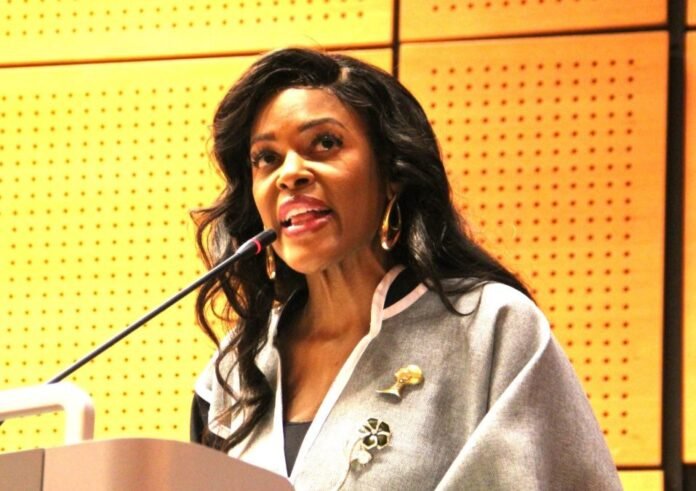

The President of the ECOWAS Court of Justice, Justice Charlyne M. Brumskine, has warned that the failure of member states to enforce judgments of the regional court amounts to denying citizens justice twice after their rights have been violated.
She urged members of the ECOWAS Parliament to use their positions in national legislatures to promote compliance with the court’s decisions and ensure that its judgments are recognised and enforced across member states.
Speaking at the opening of the Second Ordinary Session of the ECOWAS Parliament for 2026 in Abuja, Nigeria, on Friday, November 27, Justice Brumskine said the credibility of the regional judicial institution depends largely on the willingness of member states to implement its judgments.
“I would like to underscore that the credibility of any court rests on the enforcement of its judgments and a judgment that is not complied with is illegal and sometimes, in human rights, that is denied twice: first by the original violation and again by the failure to give effect to the remedy,” she said.
She stressed that judgments of the ECOWAS Court should not be treated as foreign decisions requiring separate recognition as judgments from outside the Community.
“Judgments of the ECOWAS Court are judgments of this Community; they are not foreign judgments of any of our member states,” she stated.
Justice Brumskine urged parliamentarians to support the domestication of Community legal instruments and encourage their respective governments to create the necessary legal frameworks for enforcing the court’s decisions.
Addressing Parliament for the first time as President of the ECOWAS Court, Justice Brumskine said citizens’ integration and welfare remain central to the Community’s shared mission.
She described Parliament as the institution through which citizens’ concerns are translated into the regional agenda, while the court provides a platform for seeking redress when their rights are violated.
She explained that the Parliament’s legislative, advisory and oversight responsibilities complement the court’s mandate to uphold the law and ensure fairness in interpreting and applying Community texts.
“The community texts that this Parliament helps to shape become the laws that the court interprets and applies,” she said.
She added that legislation without adjudication risked becoming merely a statement of intent, while adjudication without a sound legislative foundation lacked direction.
“This House gives our citizens a voice; the court gives them a remedy and together, our institutions give the community both its voice and its conscience,” she stated.
Regional integration, Justice Brumskine said, could only succeed when citizens, businesses and member states have confidence that Community commitments would be respected and that credible remedies are available when violations occur.
She noted that the court has developed substantial jurisprudence, particularly in human rights, through the application of the African Charter on Human and Peoples’ Rights and other international human rights instruments adopted by member states.
However, she expressed concern that many West Africans remain unaware of the court’s existence and its mandate to protect their fundamental rights.
According to her, the court is implementing its strategic roadmap, Justice 2030, to bring its services closer to citizens, particularly women, whose rights featured prominently in cases before the institution.