

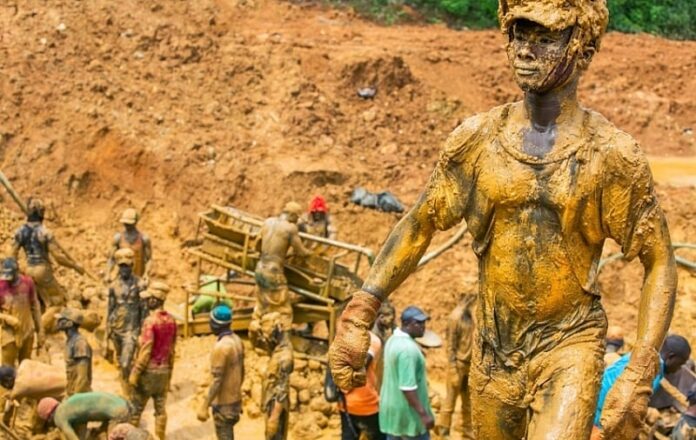

A new study has called on the government to give Metropolitan, Municipal and District Chief Executives (MMDCEs) clear legal authority, dedicated funding, and effective monitoring systems to strengthen the fight against illegal mining, warning that assigning them responsibility without the necessary resources could undermine efforts to tackle galamsey.
The study, conducted by Globe and Systems Consulting (Canada) and SysGlo Solutions Ghana Limited in partnership with researchers from the Centre for Climate Change and Sustainability Studies (CCCSS), University of Ghana, and two Canadian universities, argues that district assemblies must be empowered to lead mining oversight at the local level.
It recommends a formal legal mandate, monthly reporting requirements, and independent auditing of district mining activities to ensure transparency and accountability.
The findings come days after the maiden National Conference of MMDCEs on Illegal Small-Scale Mining, held in Kumasi on Monday, November 2, where district chief executives were urged to take a more active role in combating illegal mining.
Also read: Too many schoolchildren dying on our roads – Mahama backs TraffiTech
At the conference, MMDCEs were tasked with supporting operations by the National Anti-Illegal Mining Operations Secretariat (NAIMOS), promoting cooperative mining, prioritising land reclamation and establishing district-level anti-illegal-mining coordination mechanisms.
However, the researchers cautioned that these responsibilities would achieve little without clearly defined powers, operational funding and accountability structures.
Why district assemblies must lead the fight against galamsey
The study, conducted between February and September 2026, reviewed media reports and policy statements and interviewed officials in selected mining districts.
It identified weak local-level monitoring and enforcement as a major challenge confronting Ghana’s efforts to regulate both licensed and illegal mining operations.
According to the researchers, national regulatory institutions such as the Minerals Commission and the Environmental Protection Agency (EPA) cannot effectively monitor hundreds of scattered and constantly changing mining sites every day.
District assemblies, on the other hand, have a permanent presence in mining communities, possess local knowledge and exercise legal authority over land use and development.
The researchers therefore recommended that assemblies become frontline agencies for mining monitoring and enforcement, working alongside existing regulators rather than replacing them.
“Mining is local, so the lead in enforcement and monitoring should also be local. That is the governance fit Ghana needs but currently lacks,” Lead Researcher Dr John Boakye-Danquah said.
Assemblies already working without clear mandates
The study found that several Metropolitan, Municipal and District Assemblies (MMDAs) in mining areas already monitor mining sites, respond to complaints, support enforcement operations and participate in land reclamation.
However, these activities are largely undertaken informally, without specific mandates, standard operating procedures, compulsory reporting requirements or dedicated budgets.
Some assemblies have established task forces to register and map mining activities, remove miners from river bodies and enforce reclamation requirements.
But the researchers found that the effectiveness of these interventions often depended on the commitment of individual District Chief Executives.
The study also uncovered allegations of complicity, irregular fee collection and political interference in some districts, making it difficult to establish which assemblies are performing effectively and which were failing.
Prof Yaw Agyeman Boafo of the CCCSS said assemblies need clear regulations, digital records and independent oversight to ensure accountability.
“Assemblies need clear rules, digital records and independent oversight so that good performing districts can prove their performance and weak ones cannot hide,” he said.
District Mining Committees largely inactive
Another major concern identified by the researchers is the inactivity of District Mining Committees (DMCs).
The study found that almost all the committees became dormant after their inauguration and initial training because they lack operational funding, clearly defined responsibilities and mandatory reporting obligations.
A district finance officer interviewed for the study explained that organising committee meetings came with financial obligations, including fuel, transport and allowances for members.
Coordination between district assemblies and national regulatory institutions is also found to be weak, with limited information sharing, joint monitoring and access to a common register of mining operators and sites.
Five measures proposed to strengthen the fight against galamsey
To address these challenges, the researchers urged the government to move beyond public calls for MMDCEs to lead the fight against illegal mining and establish a practical framework to support their responsibilities.
They want the government to issue clear guidelines defining what assemblies should and should not do in mining governance, including monitoring, registration, licensing support, community engagement, reclamation follow-up, and assistance with enforcement operations.
The proposed district anti-illegal-mining coordination mechanisms should also operate under standard terms of reference to prevent them from becoming inactive committees.
The study further recommends dedicated funding for district mining oversight, formal coordination arrangements between assemblies, regulators and security agencies, and common performance indicators for assessing district-level interventions.
It also proposes mandatory monthly reports from every mining district identifying who is mining and where, alongside independent audits of mining records, accounts and reclamation activities.
The researchers believe district mining registers could eventually support the Ghana Gold Board’s (GoldBod) efforts to establish a national gold traceability system.
Dr Boakye-Danquah also called for a rapid national assessment of district mining governance, followed by targeted training for MMDCEs and key assembly officials.
“Government does not yet know which districts are ready for this role and which are not. A rapid national assessment of district mining governance, followed by targeted training for MMDCEs and core officials, would show where to begin and where support is most needed,” he said.
The research team previously organised a policy dialogue titled Beyond the Crackdown: Putting District Assemblies at the Heart of Mining Governance in Ghana on March 26, 2026.
Following the dialogue, the researchers presented their findings and a district-level implementation plan to the Ministry of Lands and Natural Resources, the Ministry of Local Government, Chieftaincy and Religious Affairs, and GoldBod.
Dr Boakye-Danquah argued that Ghana needs a more sustainable approach to tackling illegal mining rather than relying predominantly on periodic enforcement operations.
“It is time to stop pretending that the next crackdown will end galamsey,” he said.
He maintained that enforcement remains necessary and mining in water bodies must remain prohibited, but argued that bringing small-scale mining into a responsible and regulated system is essential to achieving lasting results.