

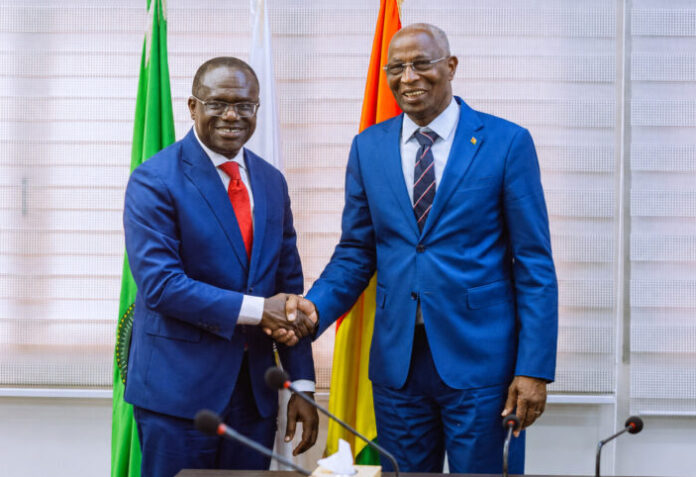

Waste management giant Jospong Group of Companies (JGC) has secured a breakthrough in its African expansion after signing a landmark public-private partnership agreement with Guinea to transform waste management in the capital, Conakry.
The agreement, which marks a significant step in the Ghana-Guinea waste management partnership, is expected to introduce a modern waste processing and recycling system, create thousands of jobs and turn urban waste into valuable economic resources.
The Executive Chairman of Jospong Group, Dr Joseph Siaw Agyepong, announced the initiative during a courtesy call on Guinea’s Prime Minister, Amadou Oury Bah, on Tuesday, November 3, 2026, in Conakry.
Also read: Tenerife striker De Miguel dies after on-field collision
The meeting followed the signing of the agreement, which is expected to strengthen economic cooperation between the two West African countries while addressing Guinea’s longstanding sanitation challenges.
Welcoming the Jospong delegation, Prime Minister Bah described the partnership as a continuation of the historic relationship between Ghana and Guinea, dating back to their independence struggles.
Dr Agyepong, who led a high-powered delegation, conveyed fraternal greetings from Ghana’s President, John Dramani Mahama, and commended Guinea’s President, Mamadi Doumbouya, for his leadership and development agenda.
The partnership, he said, would provide an African-led solution to urban sanitation challenges, arguing that African countries need sustainable industrial models rather than continued dependence on externally driven development frameworks.
“For over 30 years in Africa, governments have depended almost exclusively on World Bank and IMF frameworks to solve urban sanitation problems, which has repeatedly proven unsustainable over time,” he stated.
“What we are bringing to Guinea is a self-sustaining, circular industrial model built on localized African capacity.”
Dr Agyepong expressed Jospong Group’s commitment to supporting President Doumbouya’s Simandou 2040 development vision by transforming environmental challenges into opportunities for economic growth, public safety and employment.
He disclosed that Jospong Group operates in 29 countries, with an asset base exceeding $2.4 billion and a workforce of approximately 10,000 people.
The group also has more than 200 PhD holders specialising in environmental and waste engineering, providing the technical expertise required to execute large-scale sanitation projects.
According to him, machinery deployed in Conakry would be specifically designed to suit local terrain and operational requirements.
He cited the group’s $180 million infrastructure deployment in Lagos State, Nigeria, as evidence of its capacity to undertake major waste management projects across the continent.
The partnership will be implemented through Zoomlion Guinea Integrated Waste Solutions Limited (ZGIWSL), working with Guinea’s Ministry of Sanitation, Hydraulics and Hydrocarbons and the National Agency for Sanitation and Public Health.
The company is expected to manage key waste transfer stations, known as Zone de Tri et de Transit (ZTT), as well as waste collection in markets and major transportation routes leading to the Baritodé landfill.
Guinea’s Minister of Sanitation, Aboubacar Camara, acknowledged that Conakry has struggled with sanitation challenges for approximately three decades.
The severity of the crisis was highlighted in August 2025 when torrential rains triggered a deadly collapse at the Dar-es-Salam landfill in Gbessia, killing 30 people.
Conakry generates more than 2,500 tonnes of solid waste daily, but historically collects less than 55 per cent of the total volume.
Under the Ghana-Guinea waste management partnership, Jospong intends to move the city away from conventional waste disposal towards a circular economy in which discarded materials are recovered, processed and reused.
Waste characterisation studies show that Conakry’s waste contains 46 per cent organic matter, 18 per cent plastics, seven per cent metals, six per cent glass and six per cent paper.
Dr Agyepong has committed immediate funding towards the construction of an advanced waste processing and recovery plant.
The facility will convert organic waste into agricultural compost to support local farmers and improve food production, while plastics, glass and metals will be channelled into domestic recycling networks.
Beyond improving sanitation infrastructure, the project is expected to deliver significant employment opportunities for Guineans, particularly young people.
Minister Camara disclosed that the proposed waste processing plant would create between 2,000 and 3,000 sustainable jobs.
The initiative is also expected to improve the professional status of sanitation workers and create new opportunities across waste collection, recycling, transportation and processing.
The employment component aligns with Guinea’s Simandou 2040 development framework, which seeks to promote economic transformation and create opportunities for the country’s growing youth population.
To ensure long-term sustainability, ZGIWSL will also introduce public education and environmental awareness campaigns in collaboration with municipal authorities, traditional leaders, schools and youth organisations.
The campaigns will encourage residents to participate actively in waste management and promote responsible disposal practices.