

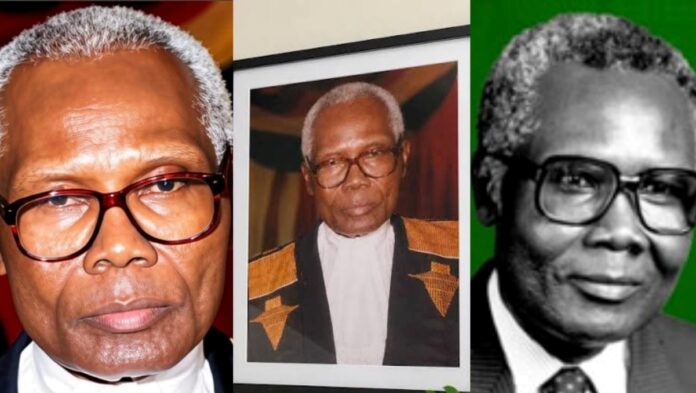

The Justice D. F. Annan legacy represents one of the most important chapters in Ghana’s democratic journey. Twenty years after the passing of the former Speaker of Parliament, his contribution to constitutional governance, parliamentary independence, and national unity remains a powerful reminder of the kind of leadership required to build lasting institutions.
As Parliament commemorates the life of the late Rt. Hon. Justice Daniel Francis Kweipe Annan, Ghana is not merely remembering an individual. The country is reflecting on the values that have sustained the Fourth Republic for more than three decades.
Justice Annan was more than a judge, more than a Speaker, and more than a public official. He was an institution-builder whose work helped transform Ghana from a period of political uncertainty into a stable constitutional democracy.
Also read: The Front pages: Friday, 17th July, 2026 (Newspapers)
His story is a lesson that democracy is not sustained only by elections and political competition. It survives through integrity, dialogue, respect for institutions, and leaders who place national interest above personal ambition.
Justice D. F. Annan legacy and Ghana’s democratic transition
One of the most significant aspects of the Justice D. F. Annan legacy was his role in Ghana’s transition from military rule to constitutional governance.
In 1984, Justice Annan was appointed a member of the Provisional National Defence Council (PNDC) and later became Chairman of the National Commission for Democracy (NCD).
The Commission embarked on nationwide consultations that allowed Ghanaians from different backgrounds to participate in discussions about the country’s political future.
Those engagements contributed significantly to the development of the 1992 Constitution, which established the Fourth Republic.
The importance of this contribution cannot be overstated. Ghana’s current democratic stability did not happen by accident. It was shaped by individuals who understood that national reconciliation and dialogue were necessary ingredients for progress.
Justice Annan’s ability to engage different sides of the political divide demonstrated that democracy requires bridge-builders, not only political actors.
A Speaker who built Parliament
When Ghana entered the Fourth Republic in January 1993, Justice Annan became the first Speaker of Parliament under the new constitutional order.
His responsibility was historic. He was not inheriting a fully developed parliamentary institution. He was helping to create one.
The Justice D. F. Annan legacy in Parliament is reflected in many of the conventions, procedures and traditions that continue to guide lawmakers today.
He led the House with fairness, humility and impartiality, earning respect from both government and opposition members.
At a time when Ghana was rebuilding democratic confidence, Parliament needed a leader who could protect its dignity and independence. Justice Annan provided that leadership.
He understood that the Speaker belongs to Parliament as an institution and not to any political party.
That principle remains one of the greatest lessons from his tenure.
Leadership beyond titles and positions
The greatness of Justice Annan was not measured only by the offices he occupied.
Before becoming Speaker, he had already built an impressive legal career, rising from the Attorney-General’s Department to become a Circuit Court Judge, a High Court Judge, and a Justice of the Court of Appeal.
Throughout his career, he was recognised for his professionalism, sound judgment and commitment to justice.
He also served Ghana in various national roles, including Chairman of the Ghana Police Council and Chairman of the National Economic Commission.
These responsibilities reflected the confidence Ghana placed in his wisdom and leadership.
The Justice D. F. Annan legacy teaches that public service is not about titles but about the impact made on society.
One of Justice Annan’s most important reflections was his belief that democracy must improve the lives of citizens.
He argued that political democracy must be supported by economic democracy and that governance must create conditions for sustainable development.
This message remains relevant today.
A democracy that produces elections but fails to improve opportunities, livelihoods and social wellbeing risks losing public confidence.
Justice Annan understood that constitutional structures are important, but they must ultimately serve the people.
The Fourth Republic must therefore continue to measure its success not only by political stability but also by how effectively it delivers development.
A lesson for today’s political leaders
The Justice D. F. Annan legacy offers important lessons for Ghana’s current generation of political leaders.
First, institutions must always come before individuals. Second, political disagreements must not destroy national cooperation. Third, public office must be approached as a responsibility, not a privilege.
Justice Annan’s life demonstrated that a leader can be firm without being hostile, influential without being arrogant, and powerful without abusing authority.
At a time when political divisions often dominate public discussion, Ghana needs more leaders who understand the value of compromise and national unity.
Memorial ceremonies and parliamentary tributes are important, but the best way to honour Justice Annan is to protect the democratic institutions he helped build. His legacy must not remain only in speeches and commemorative events.
It must be reflected in:
respect for constitutional processes;
protection of Parliament’s independence;
commitment to the rule of law;
peaceful political engagement;
accountability in public service.
The Justice D. F. Annan legacy will survive when future generations inherit stronger institutions and a democracy built on trust.
Twenty years after his passing, Ghana remembers a man whose greatest achievement was not occupying important offices but helping create systems that continue to serve the nation.
Justice Annan’s life remains a reminder that democracies are built by people who choose service over self-interest and national unity over division.
His memory deserves not only celebration but commitment.