

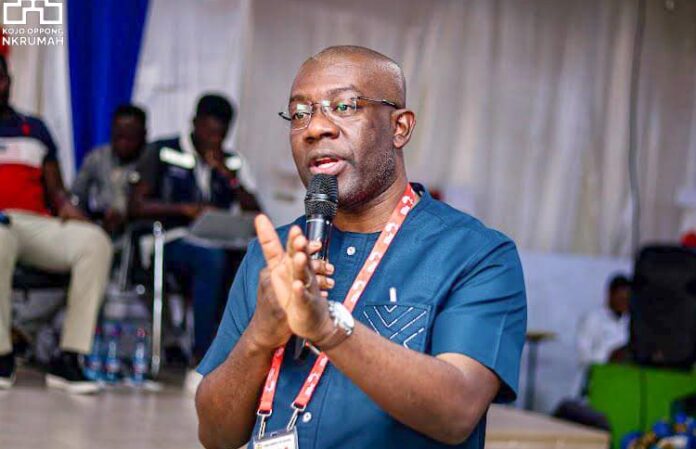

Ranking Member of Parliament’s Economy and Development Committee and Ofoase Ayirebi MP Kojo Oppong Nkrumah has accused the government of under-executing its 2026 budget by about GH¢30 billion.
According to him, the shortfall represents projects, jobs and programmes that have not been delivered as promised.
Mr Oppong Nkrumah made the allegation during debate on the 2026 Mid-Year Budget Review presented by Finance Minister Dr Cassiel Ato Forson last Thursday.
Also read: WAEC releases 2026 BECE results for 620,243 candidates
He stated that the government had made commitments to projects, jobs and programmes worth approximately GH¢30 billion that had not been executed by the middle of the year.
He argued that the under-execution of the budget is partly responsible for the lack of visible development projects in some constituencies.
“That GH¢30 billion is jobs, projects and programmes that they promised they were going to deliver,” he said.
Mr Oppong Nkrumah challenged the government’s explanation that its spending restraint is linked to the 1.5 per cent primary balance target agreed under Ghana’s International Monetary Fund (IMF) programme.
He argued that the primary balance target is supposed to be achieved after the government had executed its economic policy and should therefore not be used as a justification for failing to implement planned programmes.
The Ranking Member criticised the government’s indication that the primary balance target could be reduced from 1.5 per cent to 0.5 per cent in 2027.
He questioned whether the proposed reduction would undermine the government’s claims of fiscal discipline.
Mr Oppong Nkrumah suggested that the focus should instead be on improving revenue mobilisation to generate the resources required to finance approved programmes and projects.
He argued that stronger revenue measures, rather than reduced expenditure execution, should be the foundation of fiscal management.
The Ofoase Ayirebi MP also linked the government’s alleged underspending to challenges in flood control and disaster preparedness.
He referred to concerns raised by the World Bank about expenditure constraints and argued that insufficient spending on flood control programmes could have serious consequences.
Mr Oppong Nkrumah cited the recent flooding that resulted in deaths and missing persons as an example of the potential human cost of inadequate investment in critical infrastructure.
He challenged the government to prioritise expenditure on flood mitigation and other essential programmes instead of focusing solely on improving fiscal figures on paper.
Mr Oppong Nkrumah raised concerns about funding for agriculture, claiming that the Ministry of Agriculture required about GH¢1.6 billion for fertilisers and related programmes.
He questioned the government’s handling of funding for the sector and linked the issue to rising food prices.
The MP urged the government to consider the impact of its fiscal decisions on ordinary Ghanaians, particularly consumers and market traders.
He said the cost of essential food items, including tomatoes, is evidence of the economic difficulties facing households.
Mr Oppong Nkrumah also criticised the government’s approach to financial clearance for recruitment into the education and health sectors.
He claimed that the Education Ministry needed to recruit tens of thousands of young Ghanaians but is facing difficulties obtaining the necessary financial clearance.
According to him, similar concerns have been raised within the health sector, where the Minister for Health has expressed the need to recruit additional personnel.
He accused the government of prioritising favourable fiscal figures over the immediate needs of citizens.
The Ranking Member outlined his NPP’s vision for Ghana’s economy under a future NPP administration led by former Vice President Dr Mahamudu Bawumia.
The next NPP government, he said, would work to maintain low inflation, stabilise the Ghanaian cedi and strengthen economic management.
He argued that effective fiscal management should not simply focus on reducing expenditure but must also ensure that the economy continues to create jobs, support businesses and provide essential public services.