

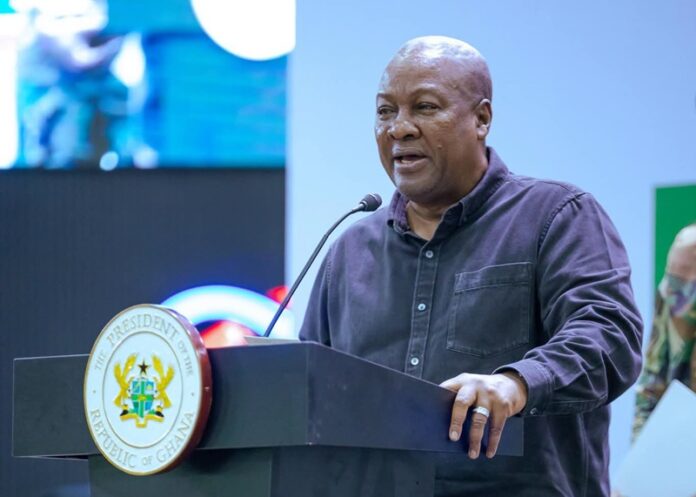

President John Dramani Mahama has announced plans to rehabilitate the Pwalugu Tomato Factory in the Upper East Region as part of a broader government strategy to expand tomato production, irrigation and agro-processing.
The President said the factory would serve as the main processing hub for tomatoes produced under a planned expansion of cultivation in the region, strengthening the connection between farmers and local industries.
President Mahama announced this during a citizens’ engagement in Navrongo as part of his working visit to the Upper East Region.
Also read: Top Zambian opposition figures arrested days after presidential vote
He said agriculture and agro-processing would form the largest component of the government’s proposed New Economy programme, which is expected to focus on seven strategic sectors.
According to President Mahama, the government plans to invest $2.5 billion annually for four years, translating into a total planned investment of $10 billion across the seven sectors.
“Every year, for the next four years, we’re going to invest $2.5 billion in those seven pillars,” he said.
President Mahama said agriculture and agro-processing would receive the largest share of the planned investment, accounting for 50 per cent, or $5 billion, of the total $10 billion.
“The biggest is agriculture and agro-processing. And that’s where the Upper East comes in,” he said.
He assured residents of the Upper East Region that the area would benefit from the planned investment, particularly through the expansion of irrigation infrastructure.
The President said increased access to irrigation would allow farmers to produce throughout the year instead of relying solely on rainfall.
He added that year-round farming could create new opportunities for young people to engage in agriculture during both the rainy and dry seasons.
President Mahama said the government is targeting about 2,500 acres of land for tomato cultivation, with the Pwalugu Tomato Factory expected to become the centre of the processing chain.
“We can bring in 2,500 acres of land under tomato production. And the Pwalugu tomato factory is going to be the epicentre of it,” he said.
He explained that rehabilitating the factory would allow tomatoes produced in the Upper East Region to be processed locally and distributed to markets across Ghana.
The plan, according to the President, is also expected to strengthen the relationship between farmers and agro-processing companies, reduce post-harvest losses and promote local value addition.
He said the Upper East had significant potential to produce tomatoes, vegetables and other crops needed to supply the domestic market.
“We’ve started. We have the tomato revitalisation project that is taking place here,” he said.
Beyond tomato production, President Mahama announced plans to complete the Tamne irrigation dam to support dry-season farming in four districts in the Bawku area.
He said the project would expand access to irrigation and enable farmers in the area to increase production throughout the year.
“We’ll finish the Tamne irrigation dam so that the four districts in the Bawku area can also go into their dry-season production,” he said.
President Mahama also outlined plans to increase domestic onion production to reduce Ghana’s dependence on imported onions from Niger.
He said expanding irrigation would enable farmers to cultivate onions on a larger scale and substitute imported produce with locally grown onions.
“We want to cut down the amount of onions we import from Niger. And if we put enough land under irrigation, we should be able to import, substitute, and produce our own onions,” he said.
The initiative is expected to contribute to Ghana’s food security objectives while reducing reliance on imported agricultural products.
The planned rehabilitation of the Pwalugu Tomato Factory, expansion of irrigation infrastructure and completion of the Tamne irrigation dam form part of the government’s broader agricultural transformation agenda.