

The Minority Caucus in Parliament has demanded the immediate repeal of Sections 207 and 208 of the Criminal and Other Offences Act, 1960, describing the provisions as a revival of Ghana’s repealed criminal libel regime that is now being used to silence critics of the government.
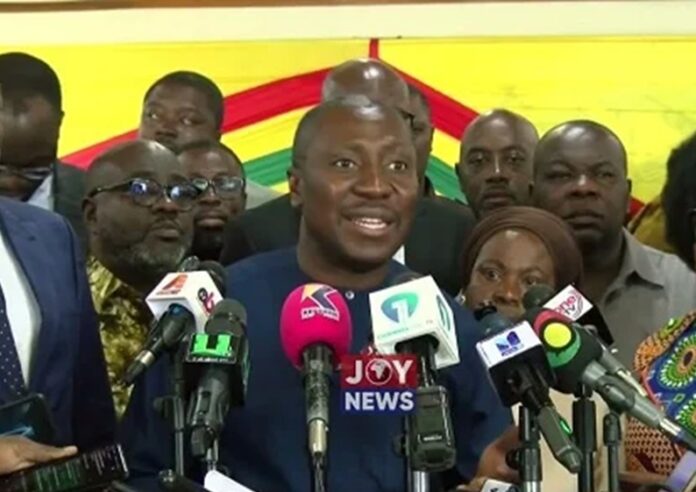
Addressing a press conference on Friday, July 17, 2026, Minority Leader Alexander Afenyo-Markin said the recent conviction and one-year prison sentence handed to TikToker Camila Alhassan should concern every Ghanaian, regardless of political affiliation.
Camila Alhassan was convicted after publishing videos alleging that President John Dramani Mahama sacrificed 32 cows for ritual purposes, among other claims.
Also read: Two Ghanaians petition ICC to probe xenophobic killings in South Africa
“We say plainly: this should trouble every Ghanaian, whatever their party colours,” Afenyo-Markin stated.
He argued that the custodial sentence sends a chilling message to citizens who use social media. “It is a warning shot fired at every Ghanaian who owns a smartphone.”
Sections 207 and 208 of the Criminal and Other Offences Act Say
The Minority explained that:
Section 207 criminalises offensive conduct conducive to a breach of the peace.
Section 208 criminalises the publication of false news likely to cause alarm or disturb public peace.
Both offences are classified as misdemeanours and attract prison terms of up to three years upon conviction.
According to the Minority leader, the provisions have become modern substitutes for Ghana’s criminal libel laws, which were repealed in 2001 under former President John Agyekum Kufuor, following reforms championed by then Attorney-General Nana Addo Dankwa Akufo-Addo.
“Twenty-five years after 2001, it is time to finish the job,” Afenyo-Markin said.
He maintained that although criminal libel laws were abolished, Sections 207 and 208 continue to produce the same effect by criminalising speech.
Arrests under Sections 207 and 208
The Minority cited what it described as a growing pattern of arrests and prosecutions under the two provisions.
Among the cases mentioned were:
Camila Alhassan – sentenced to one year’s imprisonment.
Kwame Baffoe (Abronye DC) – remanded before being granted GH¢100,000 bail.
Alhassan Abdul Rahaman – arrested in Tamale over a Facebook post.
Alfred Ababio Kumi – detained during a pre-dawn security operation after petitioning the President.
David Essandoh – arrested over a social media post on persistent electricity outages.
Counsellor George Lutterodt – currently facing charges under Section 207.
The Minority accused the government of selectively applying the law against critics while allegedly overlooking similar conduct by supporters of the governing National Democratic Congress (NDC).
“Let us not be delicate about this, because delicacy will not serve the truth. The label has changed. The purpose, and the effect on the citizen sitting in a cell today, has not,” he stated.
Appeals to President Mahama
The Minority appealed directly to President John Dramani Mahama, reminding him of his background as a journalist and former member of the Ghana Journalists Association (GJA).
According to the caucus, a President with journalism experience should defend free expression rather than oversee criminal prosecutions arising from speech.
“A President who understands, from his own career, what it is to search for the right word against a deadline ought to be the last person in this Republic to preside over the criminal prosecution of a citizen for an insult.”
Four key demands
The Minority outlined four immediate demands:
Withdraw all ongoing prosecutions under Sections 207 and 208.
Release every person currently serving sentences under the two provisions.
Pass legislation repealing Sections 207 and 208 without delay.
Guarantee publicly that no Ghanaian will face criminal prosecution for speech that is merely critical, embarrassing, or unwelcome to those in authority.
The Minority leader argued that Ghana is no longer leading Africa on press freedom and freedom of expression.
It pointed to reforms in other jurisdictions, including the United Kingdom, which removed the offence of “insulting” from its Public Order Act in 2014; Kenya, whose Court of Appeal struck down false-publication offences in March 2026; and Zambia, whose High Court invalidated similar provisions in 2014.
“Ghana was once the leader on this question in Africa. We should not now be the country still holding on to a law that London, Nairobi and Lusaka have each moved beyond.”
Bill before Parliament
Afenyo-Markin disclosed that the Minority has already laid a private member’s bill before Parliament seeking to repeal Sections 207 and 208.
He urged the Majority Caucus to support the legislation, insisting the issue transcends party politics.
“This is not, and must not be allowed to become, a partisan issue. A law that can jail a government critic today can jail a government supporter tomorrow,” he stated.