

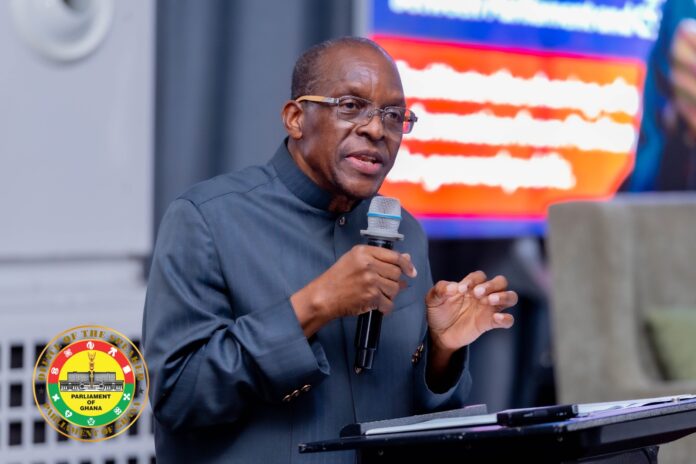

Speaker of Parliament Alban Bagbin has called for a sustained and institutionalised partnership between Parliament, academia and civil society organisations (CSOs) to strengthen economic governance and public financial management in Ghana.
Speaking at the launch of the maiden Information-Sharing Session between Academia, Civil Society Organisations and Committees of Parliament in Accra on Wednesday, the Speaker said Parliament could no longer operate in isolation from academic research and evidence or the grassroots perspectives provided by civil society groups.
“Parliament cannot be the sole police of our purse,” Rt. Hon. Alban Sumana Kingsford Bagbin told the gathering.
Also read: Front Pages: Top newspaper headlines for Thursday July 30th, 2026
The event brought together Members of Parliament, representatives of the World Bank and the United Kingdom Foreign, Commonwealth and Development Office, the Institute of Statistical, Social and Economic Research (ISSER), academics, CSO leaders, diplomats and journalists.
Economic governance partnership
Speaker Bagbin said Parliament has the constitutional responsibility to make laws, approve the allocation of national resources and hold the Executive accountable.
However, he noted that academia plays a critical role by generating research and evidence to improve understanding of national challenges. At the same time, civil society organisations help amplify citizens’ concerns and monitor the implementation of government policies and programmes.
According to him, structured collaboration among Parliament, academia and civil society has historically been limited, meaning that valuable research and public-interest findings do not always reach parliamentary committees and legislative deliberations.
He said the new information-sharing initiative was therefore an important step towards ensuring that evidence-based research and citizens’ perspectives inform parliamentary oversight and policymaking.
The Speaker described the launch as timely, particularly as Parliament considers the 2026 Mid-Year Fiscal Policy Review.
He stressed that effective parliamentary oversight of the public purse must go beyond relying solely on official government reports, urging Parliament to strengthen its capacity to scrutinise public finances and government expenditure.
“As a Parliament, we only have to doze off for a second and government goes on a shopping spree at the expense of the fundamentals of life,” he cautioned.
He added that an “untrained guard dog is a danger to even its master,” emphasising the need for Parliament to continually improve its capacity to protect the public purse and hold the Executive to account.
Open Parliament reforms
Rt. Hon. Bagbin also outlined several reforms aimed at making Parliament more open, transparent and responsive to citizens.
These include the development of an Open Parliament Plan, the establishment of a multi-stakeholder Parliamentary Open Government Steering Committee, an electronic petitions platform, live broadcasts of parliamentary proceedings and the organisation of Open Parliament Week.
He said the restructuring of the former Public Affairs Department into specialised directorates, including the Citizens’ Bureau, Media Relations, Public Engagement, the Visitors’ Centre and Broadcasting, demonstrates Parliament’s commitment to improving public access and citizen participation.
The Speaker described the Citizens’ Bureau as an important institutional bridge between Parliament and the people, ensuring that lawmakers remain informed by the experiences, concerns and aspirations of citizens.
Sustained collaboration
The Speaker urged parliamentary committees, particularly the Committee on Economy and Development, the Budget Committee, and the Committee on Independent Constitutional Bodies, to treat the engagement as the beginning of a continuous institutional relationship rather than a one-off event.
He also encouraged academic institutions and civil society organisations to provide timely, objective and policy-relevant research to Parliament while continuing to hold public institutions, including Parliament itself, to high standards of transparency and accountability.