

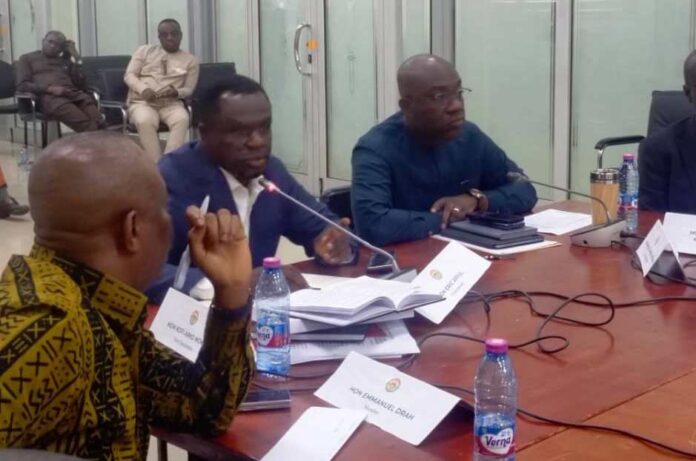

Parliament is set to begin a comprehensive review of the performance of ministries, departments, agencies (MDAs) and Metropolitan, Municipal and District Assemblies (MMDAs) following the launch of the 2025 Annual Progress Report (APR) by the National Development Planning Commission (NDPC).
The exercise, announced on Thursday, July 17, forms part of Parliament’s constitutional oversight responsibilities and is expected to assess how effectively public institutions implemented government policies, programmes and budgets during President John Dramani Mahama’s first year in office.
Launching the review process, the Chairman of Parliament’s Committee on Economy and Development last Friday, MP for Amenfi West Hon. Eric Afful, described the Annual Progress Report as one of Ghana’s most important accountability tools for measuring government performance.
Also read:
President Mahama appeals to global north to support Accra Reset Agenda
Police launch fresh legal battle against Camila Alhassan after jail sentence
According to him, the APR provides a detailed assessment of how ministries, departments, agencies (MDAs) and district assemblies utilised public resources to achieve national development targets.
The report evaluates implementation of government programmes; budget execution; service delivery performance; achievement of development targets and utilisation of public resources.
The findings will guide engagements with heads of public institutions on their achievements, implementation challenges and measures being adopted to improve service delivery.
MDAs and MMDAs
Mr. Eric Afful announced that all Chief Directors, Chief Executive Officers of state agencies and Metropolitan, Municipal and District Chief Executives (MMDCEs) under its mandate will be invited to appear before Parliament.
The institutions are expected to provide accurate and verifiable performance reports,
details of budget utilisation; progress on approved government programmes and evidence of outcomes achieved with public funds
He stressed that institutions must attend fully prepared and accompanied by their technical teams.
It warned that failure to honour invitations without reasonable justification would be treated seriously as part of Parliament’s constitutional oversight role.
The Committee emphasised that the review process is intended to improve governance rather than punish public institutions.
According to him, the exercise seeks to promote transparency and accountability, identify policy implementation gaps, encourage institutional learning, support evidence-based decision-making and improve service delivery across the public sector.
He assured that institutions that demonstrate innovation, efficiency and strong performance would have the opportunity to showcase best practices, while those facing implementation challenges would receive constructive recommendations to improve their work.
Mr. Eric Afful said the exercise aligns with President John Dramani Mahama’s Reset Agenda, which places strong emphasis on transparency, efficient public administration and value for money in government spending.
He noted that every cedi approved by Parliament should translate into measurable improvements in the lives of Ghanaians, stressing, “Public institutions are custodians – not owners – of public resources and must account for how those resources are used.”
Public hearing
Ranking Member Kojo Oppong Nkrumah, who addressed journalists alongside the Committee Chairman, explained that the exercise is grounded in Article 87(2)(e) of the 1992 Constitution, which mandates the NDPC to evaluate national development programmes.
He disclosed that Parliament’s Committee on Economy and Development has been tasked by Speaker Alban Bagbin to oversee the review.
According to him, committee hearings will generally be conducted in public under Parliament’s Standing Orders, allowing the media and citizens to follow proceedings.
“These are public meetings, and the media are invited to cover them so that Ghanaians can see how ministries, departments and agencies have utilised public resources to achieve national development targets,” he said.
Oppong Nkrumah revealed that the Committee will extend the exercise beyond Accra by visiting regional and district assemblies to assess implementation of local development plans.
The Committee expressed confidence that recommendations from the review would help strengthen public sector governance, improve policy implementation and reinforce accountability across government institutions.
It urged civil society organisations, development partners and the media to support the process to ensure transparency and build greater public confidence in Ghana’s democratic governance.