

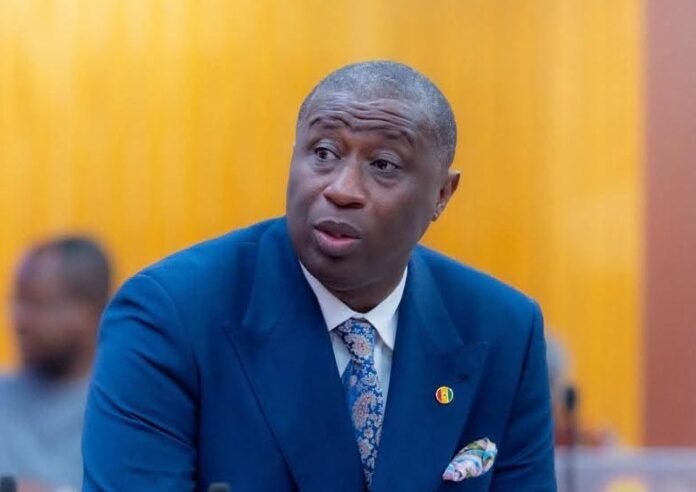

The Member of Parliament for Okaikoi Central, Patrick Yaw Boamah, has raised concerns over the GH¢30 billion allocation for the Mahama administration’s New Economy programme in the 2027 Budget, warning that keeping the funds under the control of the Ministry of Finance could weaken parliamentary oversight.
He urged Parliament to ensure that the allocation is properly appropriated to the respective sector ministries to guarantee transparency, accountability and effective monitoring of public expenditure.
Contributing to the 2027 Budget debate in Parliament, Mr Boamah questioned why the Finance Minister, Dr Cassiel Ato Forson, had placed the GH¢29.99 billion capital expenditure allocation under the New Economy instead of distributing it among the ministries responsible for implementing the various growth initiatives.
Also read: Bagbin declares responsible communication a democratic imperative, warns against misinformation
According to him, the arrangement could give the Finance Ministry excessive control over funds intended for sectors such as agriculture, mining, telecommunications and energy.
He argued that the GH¢3 billion earmarked for agriculture, GH¢2.2 billion for mining and GH¢1 billion for telecommunications, among other allocations, should be transferred to their respective ministries.
“If it’s for agric and for agribusiness, he should send it there. If it’s for mining or the energy sector, he should send it there. He shouldn’t keep it at the Ministry of Finance,” he told Parliament.
Mr Boamah warned that without proper appropriation, sectoral committees and Parliament’s oversight institutions could struggle to effectively monitor how the funds are utilised over the next four years.
The Okaikoi Central MP also criticised the 2027 Budget for failing to provide a sufficiently deliberate package of incentives to support indigenous businesses and stimulate employment creation.
Referencing Nigerian billionaire Aliko Dangote, he argued that Ghana must deliberately support local entrepreneurs to build businesses capable of competing across Africa and beyond.
He cited Ghanaian business figures and companies, including Manet, Devtraco, Imperial Homes, Ernest Chemist, Tobinco, Kinapharma and Springfield, as examples of local enterprises that have contributed to national development.
Mr Boamah argued that the private sector is mentioned 22 times and employment 22 times in the budget, but questioned whether the fiscal measures proposed would adequately support businesses to expand and create jobs.
He maintained that no foreign investor would develop Ghana in place of Ghanaians, insisting that local entrepreneurs needed targeted government support.
The MP further questioned the GH¢100 million provision for judgment debt payments in the 2027 Budget, asking whether the Finance Minister anticipated additional legal liabilities or had measures to prevent further claims against the state.
He cited a judgment debt of more than GH¢680 million involving the Ghana Revenue Authority and Safaritech, as well as outstanding cases involving Ghana Water Company Limited and Tullow Oil.
He urged the government and state institutions to honour contractual obligations to prevent unnecessary litigation and the accumulation of judgment debts.
Mr Boamah also criticised a directive reportedly issued by the Deputy Finance Minister on October 12, 2026, to more than 164 state-owned enterprises and public institutions, instructing them to stop paying monthly sitting allowances to board members.
He argued that regular board meetings are necessary for effective corporate governance and the development of state-owned companies.
The Okaikoi Central MP also disagreed with Dr Forson’s description of certain expenditures, including AstroTurf projects, air tickets, per diems, workshops and conferences, as wasteful spending.
He defended investments in community sports infrastructure, citing AstroTurf projects in New Fadama and Apenkwa, which he said had benefited from support from Ghana Gas and GNPC.
He argued that such facilities provide important recreational and social benefits to communities and should not automatically be classified as wasteful expenditure.
Mr Boamah additionally questioned the government’s proposed 1,450-megawatt power plant in the Central Region, demanding clarity on its financing arrangements and the availability of dedicated gas infrastructure to support the project.
He urged the government to prioritise the development of the Gas Processing Plant 2 at Atuabo to increase gas supply to industries.
The MP said the 2027 Budget lacked a sufficiently deliberate strategy to support private sector growth, address youth unemployment and strengthen the country’s power generation capacity.