

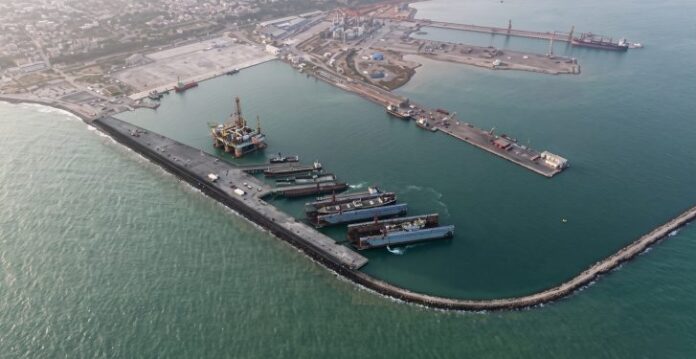

Construction is due to begin on a US$137 million ship-repair and dry-docking facility at Takoradi Port, advancing a project that could change where vessels operating in the Gulf of Guinea go for maintenance.
Known as Project Shiprite, the facility is being developed by Prime Meridian Docks Ghana under a 25-year concession with the Ghana Ports and Harbours Authority. The project is designed to service vessels up to 200 metres long.
Today, ships needing scheduled dry docking or ad hoc repairs may have to sail for 10 to 14 days to facilities in Walvis Bay, Namibia, or Las Palmas, Spain.
Also read: Gov’t won’t borrow to finance New Economy Programme – Ato Forson
The commercial case is clear: bring repair services closer to shipping routes, reduce vessel downtime and retain more expenditure within the region.
But the project’s economic value will depend on whether the facility can attract enough vessels, deliver reliable repairs at competitive prices and build a skilled local workforce. A port asset becomes a maritime hub through sustained use, not construction alone.
The project has reached financial close with backing from a consortium that combines local and international capital. PIDG, through its investment arm InfraCo, committed US$9.7 million in equity and shareholder financing.
Its investment helped unlock more than US$100 million in senior debt and mezzanine finance from development finance institutions and a local pension fund. The broader financing group includes Afreximbank, the African Development Bank, the Trade and Development Bank, Petra Pension Schemes and Origen Private Debt Fund, alongside equity from ARM-Harith Infrastructure Fund and the project developer.
That structure matters beyond this project. Infrastructure with long construction periods and uncertain early revenues can struggle to attract private capital on its own. Development finance can help absorb some of that risk and make commercial lending possible.
The participation of a local pension fund also offers a route for domestic long-term savings to finance productive infrastructure, though the returns and risks will ultimately depend on the project’s performance.
The project is expected to create up to 430 direct jobs, with around 30.00% targeted for women. A separate US$300,000 technical assistance grant from PIDG will support a 24-month Gender Impact Enhancement Programme, including skills development, certification and workplace integration for women in technical roles.
These targets give the project a workforce ambition beyond the construction phase, but achieving them will require training pathways into specialised occupations and sustained recruitment as the facility expands.
For Ghana, the strategic opportunity is to capture part of a service market that currently sends ships outside the Gulf of Guinea. If vessel operators can complete mandatory docking and repairs in Takoradi, they could save sailing time and fuel, while Ghanaian firms and workers gain opportunities in engineering, maintenance, logistics, supply and technical services.
The project could also reduce emissions associated with long-distance diversions, although the scale of those savings will depend on how many vessels use the facility and how far they would otherwise have travelled.
The effects will not be automatic. Shipowners will compare price, technical standards, turnaround time, safety and the availability of spare parts before choosing Takoradi. Delays, inconsistent service or limited access to specialist inputs could weaken the value of proximity.
The facility will need reliable utilities, port access and logistics, as well as trained technicians and suppliers capable of meeting international requirements.
Local value retention will be another measure of success. The project may keep repair expenditure in the region, but the domestic benefit will depend on how much work is performed by Ghanaian workers and firms, how much equipment and expertise must be imported, and whether local suppliers can meet the yard’s standards.
The employment forecast is significant, but job numbers alone will not show whether Ghana is building lasting technical capability.
Prime Meridian Docks chief executive Stanley Ahorlu said the company was “focused on delivering a reliable ship repair facility at Takoradi, developing Ghanaian technical skills and creating opportunities for local businesses.”
That commitment sets out the project’s central test: convert the physical asset into a reliable operating business that creates demand for local expertise and suppliers.
The 25-year concession gives the developer time to establish operations and earn returns, while placing importance on clear oversight of the partnership.
GPHA’s role will extend beyond providing a site: the public interest will require transparent performance expectations, safeguards over the port’s operations and regular reporting on employment, local procurement and service delivery.
The available project information establishes the concession period and financing structure, but the full commercial terms and performance benchmarks are not detailed in the public announcements cited here.
Shiprite is also being presented as part of the UK–Ghana Growth Partnership, which identifies the facility as a major investment in maritime infrastructure, skills and jobs.
That political backing can help bring partners together, but the project’s long-term case will depend less on the partnership’s branding than on its ability to compete for regional business once construction is complete.
The start of construction marks a shift from financing and planning to execution. The next milestones will be delivery on time and within budget, recruitment and training, and the arrival of vessel operators willing to use Takoradi for repairs.
Those will determine whether Ghana captures recurring service exports or simply adds new infrastructure to the port.
Project Shiprite offers a practical test of Ghana’s ambition to move up the maritime value chain. The opportunity is not only to host a dock, but to develop the people, firms and operating standards that make the dock commercially useful.
If that ecosystem takes root, Takoradi could become a regional service centre. If it does not, the facility’s scale and financing will matter far less than its utilisation.
NorvanReports