

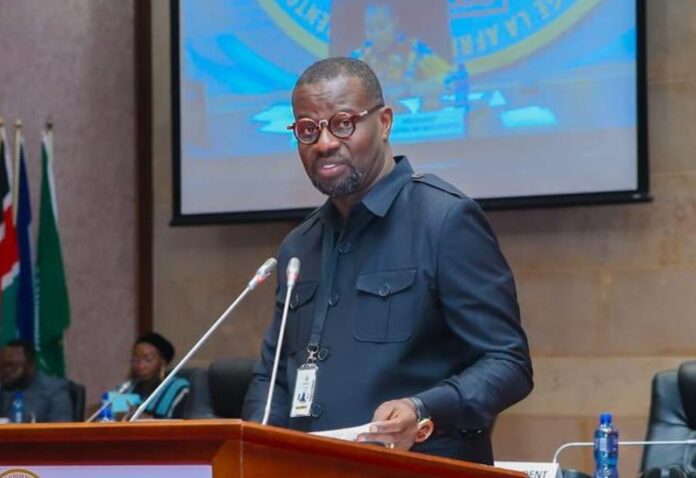

Minority Chief Whip and Nsawam-Adoagyiri MP Frank Annoh-Dompreh is leading a major Pan-African campaign to formally recognise, regulate and protect African traditional medicine as part of national healthcare systems across the continent.
The Chairman of the Pan-African Parliament’s Committee on Health, Labour and Social Affairs has presented a comprehensive report and sponsored a landmark resolution calling for the development of a continental Model Law on African Traditional Medicine and the Protection of Local Knowledge.
Mr Annoh-Dompreh argued that Africa could no longer afford to neglect a healthcare system that continues to serve millions of people, particularly those in rural and underserved communities.
Also read: Minority rejects Fiscal Electronic Device deal as ‘blank cheque’, Threatens RTI Action
Traditional medicine, he said, should no longer be treated merely as an alternative to conventional healthcare but should be safely integrated into national health systems through scientific research, regulation, quality assurance and appropriate legislation.
The proposal was presented during the First Ordinary Session of the Seventh Parliament of the Pan-African Parliament in Midrand, South Africa.
The initiative comes at a time when African countries continue to face challenges including maternal and neonatal deaths, limited access to healthcare and the need to strengthen health sovereignty following the COVID-19 pandemic and other public health emergencies.
The recommendations followed a joint Parliamentary Oversight Mission conducted by the Pan-African Parliament Committee on Health, Labour and Social Affairs and the Africa Centres for Disease Control and Prevention (Africa CDC) Regional Office in Lusaka, Zambia, from December 3 to 6, 2025.
The mission formed part of the Pan-African Parliament’s oversight mandate to monitor the implementation of key African Union health policies, Agenda 2063, the African Union Health Strategy 2016–2030, the Continental Framework for Reproductive, Maternal, Newborn, Child and Adolescent Health and Nutrition, the Maputo Plan of Action and the Sustainable Development Goals, particularly SDG 3.
The delegation consulted Zambia’s Minister of Health, government officials, Africa CDC experts, Members of Parliament, development partners, healthcare professionals, community health workers and traditional health stakeholders.
A major outcome of the mission was the Committee’s focus on the role of African traditional medicine in improving maternal and neonatal healthcare.
According to the report, traditional birth attendants and herbal practitioners remain the first point of healthcare for millions of Africans, particularly women living in remote communities where access to hospitals and qualified healthcare professionals is limited.
Rather than dismissing indigenous healthcare practices, the Committee recommended that African governments establish legal and regulatory frameworks to support scientific research, clinical validation, product standardisation, licensing and quality assurance.
The Committee also called for stronger protection of indigenous medical knowledge.
Mr Annoh-Dompreh said preserving knowledge of African traditional medicine is not only a healthcare concern but also an issue of cultural preservation, scientific innovation and economic development.
He therefore urged the Pan-African Parliament to prioritise the development of a Pan-African Model Law on African Traditional Medicine and Protection of Local Knowledge to harmonise legal frameworks across Member States.
The report also highlighted Africa’s growing quest for health sovereignty.
Lessons from COVID-19, Ebola, Mpox and Marburg Virus Disease have exposed the continent’s dependence on external funding, imported medicines, vaccines, pharmaceutical products and international supply chains.
The Committee endorsed investments in vaccine research, local pharmaceutical manufacturing, digital disease surveillance and African-led scientific innovation.
It said Universal Health Coverage could not be achieved unless African countries strengthened their capacity to finance, manufacture and manage their own healthcare systems.
Following deliberations, the Pan-African Parliament adopted resolutions calling on Member States to increase domestic investment in primary healthcare, strengthen maternal and neonatal services, recruit more healthcare professionals, improve emergency obstetric care, expand digital health systems and strengthen medical supply chains.
The Parliament also called for robust legal frameworks governing traditional medicine, including accreditation of practitioners, scientific validation of herbal medicines, protection of indigenous knowledge and collaboration between traditional healthcare providers.
The Committee on Health, Labour and Social Affairs has been mandated to work with Africa CDC, the African Medicines Agency and other stakeholders to develop a continental Model Law on Traditional Medicine covering research, licensing, manufacturing, commercialisation and ethical use.
The Parliament also called for stronger health security measures, including improved pandemic preparedness, local manufacturing, biosafety, biosecurity and cross-border disease surveillance.
The resolutions mark a significant push to reshape Africa’s healthcare landscape by combining modern medicine with scientifically regulated traditional medicine while strengthening health security, legislative harmonisation and local ownership of healthcare systems.