
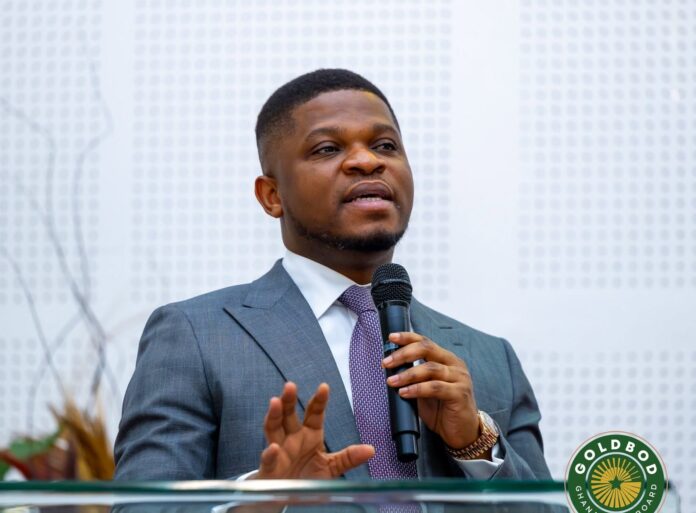

The Chief Executive Officer of the Ghana Gold Board (GoldBod) has called for a fundamental restructuring of Ghana’s mining sector, insisting that host communities must transition from being mere land donors to active economic shareholders in the country’s mineral wealth.
According to him, Ghana’s social license for mining cannot be sustained if communities continue to experience poverty, unemployment, poor infrastructure, and environmental degradation despite hosting valuable mineral resources.
“We cannot continue to mine gold from the soil of our communities while poverty, lack of access to potable water, poor roads, youth unemployment and weak local economies remain the daily reality,” he declared.
Also read: Ga South: Spiritualist arrested for attempted abduction of girl
Sammy Gyamfi was speaking at the National Mining Dialogue 2026 in Accra on Tuesday, August 18, 2026, under the theme “Rethinking the Social License to Operate.”
He stressed that the social license goes beyond legal permits, depending fundamentally on public confidence that mineral resources benefit both the nation and host communities.
The GoldBod CEO pointed to gold’s dominance in Ghana’s economy, with 2025 exports reaching approximately US$32 billion, of which gold accounted for US$20.2 billion—roughly 63.1%.
He noted that artisanal and small-scale mining (ASM) now contributes 52.4% of national gold output, with 2025 production at 5.94 million ounces, demonstrating Ghanaian participation potential when proper systems are in place.
To guide reforms, Sammy Gyamfi unveiled the “IPE model” – Involve, Protect, and Expand.
Under “Involve,” communities should have meaningful decision-making voices and benefit from higher local royalty retention. “Protect” demands treating water bodies, forests, and farmlands as non-negotiable assets, with mandatory reclamation and enforcement against irresponsible mining. “Expand” focuses on indigenous ownership, local refining, jewellery manufacturing, and support for responsible ASM operators.
He announced significant achievements, including the formal export of 170 tonnes of ASM gold since 2025, generating over US$17 billion in foreign exchange. Nearly nine tonnes of gold have been refined locally in 2026, marking a departure from offshore refining dependency.
He also unveiled plans for a Ghana Gold Village to support jewellery manufacturing and entrepreneurship, alongside a gold tokenisation programme in 2027 promoting fractional ownership for citizens.
GoldBod has demonstrated commitment to environmental protection, donating GH¢5 million and vehicles to anti-illegal mining operations, procuring speedboats for water body protection, and commencing reclamation of 50 hectares in the Tano Nimri Forest Reserve.
The institution is funding rehabilitation of water treatment plants serving over 76 communities, with additional facilities planned for next year.
A national assay laboratory will commence construction by November 2026 at Accra International Airport to address purity losses and under-declaration issues.
GoldBod is also partnering with the Ghana Geological Survey Authority for geological studies in mineralised areas to strengthen Ghanaian equity participation in mining.
Sammy Gyamfi called for collaborative action among traditional authorities, mining companies, regulators, civil society, and academia to renew the social license for mining.
He envisioned mining communities where children become geologists, engineers, jewellers, environmental scientists, and mine owners.
“If we get this right, Ghana will not only produce gold. Ghana will produce prosperous mining towns, strategic industries around its minerals and deeper community trust,” he said, urging stakeholders to commit to involving, protecting, and expanding the benefits of Ghana’s mineral resources for present and future generations.