

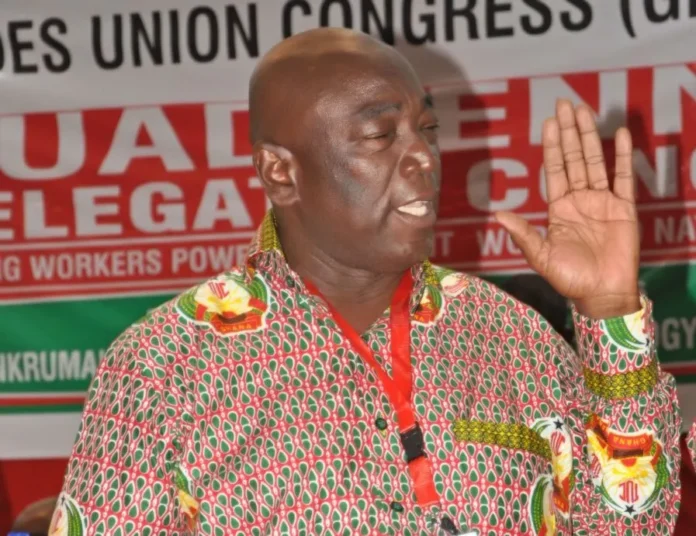

The Trades Union Congress (TUC) has strongly opposed proposals to allow dual citizens to serve as Members of Parliament (MPs).
Congress rejected the proposal, arguing that it is inconsistent with what the labour movement considers genuine citizenship and would serve no useful national purpose.
TUC Secretary General Joshua Ansah announced the labour movement’s position during a press briefing in Accra on Wednesday, September 9, 2026, where he outlined the organisation’s response to recommendations made by the Constitutional Review Committee (CRC).
Also read: Front Pages: Top newspaper headlines for Thursday, 10th September, 2026
According to him, the TUC had carefully examined the proposed constitutional reforms and would submit a detailed response to contribute to the ongoing review process.
Dual citizens as MPs
The TUC disagreed with the proposed amendment to Article 94(2)(a) of the 1992 Constitution to allow dual citizens to contest parliamentary elections.
“We strongly oppose the recommendation to permit dual citizens to become Members of Parliament. It is a direct assault on genuine citizenship and serves no useful purpose,” he said.
The TUC’s position comes as the constitutional reform process seeks to address several longstanding concerns surrounding political representation, executive power and governance.
The labour movement, however, supports the CRC’s recommendation to prevent sitting MPs from simultaneously serving as ministers, deputy ministers or regional ministers.
According to Mr Ansah, separating the Executive from the Legislature would strengthen Parliament’s independence and improve its ability to scrutinise government decisions.
“We support the recommendation that MPs should not serve concurrently as ministers, deputy ministers or regional ministers,” he stated.
The TUC does not support a separate proposal that would prevent a Member of Parliament who has resigned from being appointed a minister during the same parliamentary term.
Mr Ansah described such a restriction as unnecessary.
Council of State reforms
The TUC is also demanding changes to the composition of the Council of State to make the body more independent and effective.
The labour movement believes the current structure gives excessive influence to presidential appointees and could undermine the Council’s independence.
Mr Ansah proposed that the number of presidential appointees be capped at five.
Election of DCEs
On local governance, the TUC endorsed the CRC’s recommendation for Metropolitan, Municipal and District Chief Executives (MMDCEs) to be elected simultaneously across the country.
However, the labour movement rejected a government proposal under which the incumbent administration would nominate five candidates before a shortlist of three is presented to voters.
Mr Ansah argued that such an arrangement would continue to give central government excessive influence over local elections.
“Districts must be allowed to elect their leaders without central government determining who qualifies to contest,” he stressed.
The TUC also supported proposed changes to the composition of District Assemblies, including reserved representation for traditional authorities, women, business owners, persons with disabilities, youth groups and non-governmental organisations.
Safeguards for natural resources
The TUC further questioned the government’s rejection of all the CRC’s recommendations concerning mineral resource management.
Mr Ansah described the government’s position as “strange” and said the labour movement supports reforms designed to strengthen public ownership and accountability in the management of Ghana’s natural resources.
The TUC supports proposals to vest lands in the people of Ghana rather than in the President and wants the Lands Commission strengthened as the primary constitutional trustee and manager of public lands.
It also supports a requirement for parliamentary approval before any natural resource agreement or concession is concluded.
“We agree that Parliament must approve all natural resource agreements before they are concluded. These resources belong to the people of Ghana and must be managed transparently and in the national interest,” Mr Ansah said.