


The Minority in Parliament has called for an urgent bailout of the Bank of Ghana (BoG), warning that the central bank may struggle to effectively carry out its core mandate following what it describes as a deepening financial crisis revealed in its 2025 audited accounts.
At a press conference on Sunday, May 3, 2026, the Caucus said its analysis of the central bank’s financial statements shows that the BoG is facing policy insolvency, making external support inevitable if it is to sustain monetary policy operations.
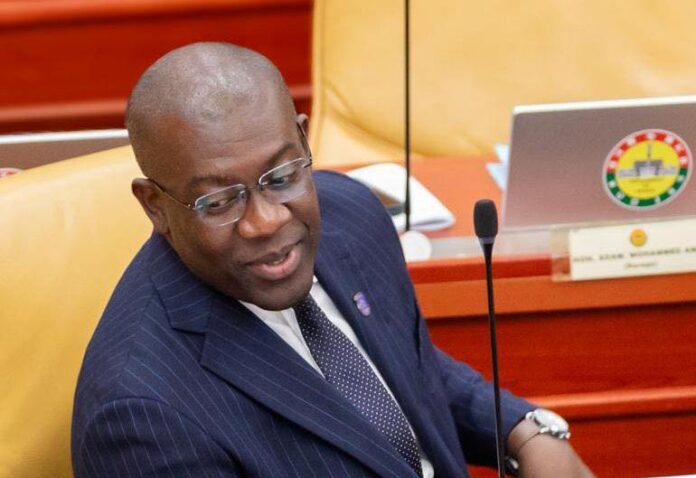
Addressing the media, the MP for Ofoase Ayirebi and Ranking Member of the Economy and Development Committee, Kojo Oppong Nkrumah, warned that once one-off revenues—particularly gains from gold sales—are excluded, the Bank lacks sufficient internally generated income to finance its key functions, including liquidity management.
Also read: Speaker donates to Ghana National Fire Service, Nadowli Kaleo Students Union and Sombo SHS
“The implication of this insolvency is that the Bank requires an urgent bailout before it can perform its core mandate,” he stated.
He argued that reliance on asset sales to support operations is unsustainable and warned that continued deterioration could undermine the effectiveness of monetary policy.
The Ranking Member further contended that the BoG’s financial position is significantly weaker than official figures suggest.
While the central bank reported a headline loss of GH¢15.6 billion, the Caucus said total comprehensive losses stand closer to GH¢34.9 billion and could reach GH¢44 billion when adjusted for gold sale proceeds.
They attributed the discrepancy to accounting treatments that shift substantial losses into other comprehensive income, thereby reducing the headline figure.
Auditors KPMG, they noted, flagged that the financial statements were prepared using the Bank’s internal accounting policies rather than full International Financial Reporting Standards (IFRS).
Mr. Oppong Nkrumah linked the BoG’s financial strain to escalating costs associated with open market operations (OMO), which reached GH¢16.7 billion in 2025.
He argued that these costs were driven largely by policy reversals, including the discontinuation of a dynamic cash reserve ratio system, changes to foreign currency reserve requirements, and adjustments to gold purchase arrangements.
These decisions, he said, forced the central bank to rely more heavily on expensive sterilisation instruments, leading to a significant transfer of public funds to commercial banks.
He cited over GH¢14.6 billion paid in interest on BoG bills in 2025, which he said contributed to strong profitability in the banking sector, even as private-sector credit growth slowed.
“This is effectively a transfer from the public balance sheet to private balance sheets,” he said.
The Minority also warned of broader economic consequences, including reduced access to credit for businesses, slowing private-sector activity, persistent cost-of-living pressures, and rising youth unemployment.
They stressed that macroeconomic stability must translate into tangible improvements in livelihoods.
Mr. Oppong Nkrumah also condemned the handling of the BoG’s financial disclosures, accusing the governing National Democratic Congress (NDC) of politicising the process. He argued that the premature public discussion of the accounts by party officials undermines the independence and credibility of the central bank.
Despite the sharp criticism, the Ranking Member said the Minority would soon present policy proposals aimed at restoring the Bank’s financial health and operational independence.
“Our duty is not just to point out the problems, but to offer solutions,” he said, adding that further engagements with the public will outline specific reform measures.