


Parliament’s Economy and Development Committee Chairman, Eric Afful, has defended the financial position of the Bank of Ghana (BoG), insisting that its reported losses are not a sign of failure but rather the inevitable cost of stabilising the economy after a period of severe distress.
According to him, the central bank’s GH¢15.6 billion loss in 2025 and its negative equity position should be viewed within the broader framework of policy-driven interventions.
“What we are seeing is not institutional weakness but the financial reflection of deliberate policy actions taken to restore stability in the economy,” he stated.
Also read: The world’s likely oldest dog finds new home after outliving owner
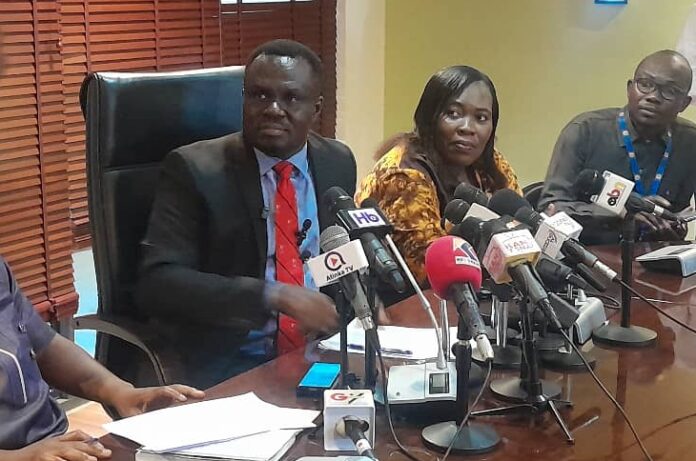
Speaking at a press briefing on Tuesday in response to the Minority’s claim that Bank of Ghana is policy insolvent, Chairman of the Committee, Eric Afful, emphasised that the BoG cannot be assessed using the same standards as commercial banks, as its primary mandate is not profit-making but economic stabilisation.
According to Mr. Afful, central banks globally often incur losses during periods of aggressive monetary tightening, particularly when tackling inflation and currency volatility.
“Central banking is about safeguarding the economy. The balance sheet often reflects the cost of that responsibility,” he explained.
He identified major policy measures that contributed to the BoG’s financial outturn, including the Domestic Debt Exchange Programme (DDEP) and intensive liquidity management operations.
The DDEP, while crucial for restoring debt sustainability, led to a sharp decline in interest income for the central bank. Additionally, Open Market Operations aimed at controlling inflation generated significant interest expenses.
“These were not avoidable costs. They were necessary interventions to prevent deeper economic instability,” Mr. Afful noted.
He also pointed to valuation losses arising from the appreciation of the Ghana cedi and accounting charges linked to gold reserve accumulation as contributing factors.
Despite the financial losses, the Committee Chairman pointed to strong macroeconomic gains as evidence that the BoG’s policies are yielding results.
“Inflation has dropped to single digits, the cedi has strengthened significantly, and Ghana’s Gross International Reserves have increased, providing improved import cover. Economic growth has also rebounded, with both overall GDP and non-oil sectors recording solid expansion.”
“The outcomes are clear – stability is returning, confidence is improving, and the economy is on a recovery path,” Mr. Afful said.
Addressing concerns about the Bank’s negative equity, Hon. Erif Afful reassured the public that this does not affect its ability to function effectively.
“Negative equity does not mean insolvency in central banking. The Bank of Ghana remains fully capable of executing its mandate,” he stressed.
He added that plans to recapitalise the central bank will further strengthen its financial position in the coming years.
He urged stakeholders, including analysts and the media, to adopt a more nuanced interpretation of central bank financial statements.
“We must move beyond headline figures and focus on the broader economic outcomes. That is where the real story lies,” Mr. Afful concluded.