

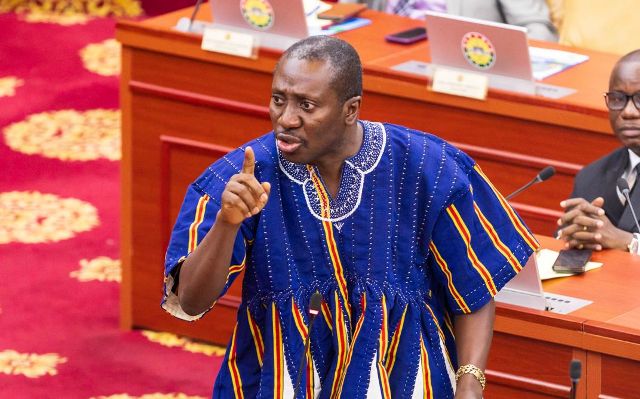

The Minority Caucus in Parliament has intensified calls for accountability over Ghana’s flood management efforts, demanding that the report of the government’s Anti-Flood Taskforce be presented before Parliament for scrutiny.
The demand follows fresh flooding incidents across several parts of Accra after recent heavy rains, reigniting public concern over the effectiveness of interventions introduced to tackle the capital’s chronic flooding problem.
The issue came under intense discussion on the floor of Parliament during a debate sparked by the latest floods that affected communities across the Greater Accra Region.
Also read: Free SHS suppliers to picket at Education Ministry over GH¢50m debt
Speaking during the debate, Minority Leader Alexander Kwamena Afenyo-Markin questioned the impact of the task force, noting that while its establishment received significant public attention, little has been seen in terms of tangible outcomes.
“The formation of the task force was widely publicised. Its results, however, have been conspicuously silent,” he stated, backing calls by the Member of Parliament for Weija-Gbawe for the taskforce’s findings and recommendations to be formally submitted to Parliament.
According to the Minority, presenting the report would allow lawmakers to assess progress made so far and determine whether the measures being implemented are adequate to address recurring flood disasters.
Responding to the concerns, Majority Leader Mahama Ayariga argued that Accra’s flooding challenge is a complex issue that cannot be resolved within a year of the task force’s creation.
He maintained that comprehensive studies, planning, and significant financial resources would be required before meaningful progress could be achieved.
“This is not a problem that can be solved within one year. A lot of studies are required, a lot of fundraising is required, and I believe the task force will achieve some success if given the needed time,” he said.
The debate also drew contributions from the Member of Parliament for Klottey Korle, Zanetor Agyeman-Rawlings, who expressed concern about the heavily silted Odaw River, warning that its condition continues to pose a major flood risk to surrounding communities.
The discussion was triggered by a statement from the Second Deputy Minority Chief Whip and MP for Weija-Gbawe, Jerry Ahmed Shaib, who called for Metropolitan, Municipal, and District Chief Executives in flood-prone areas to be summoned before Parliament to explain the flood prevention measures being implemented in their jurisdictions.
Adding his voice to the debate, former Works and Housing Minister and MP for Ofoase-Ayirebi, Kojo Oppong Nkrumah, attributed the persistent flooding largely to inadequate funding for drainage and flood-control projects.
According to him, budgetary allocations approved for major flood mitigation programmes are often not released, undermining efforts to improve drainage infrastructure and protect vulnerable communities.
The renewed parliamentary debate underscores growing pressure on government agencies to provide clear answers on flood management strategies as residents continue to face the devastating effects of seasonal flooding across the capital.