

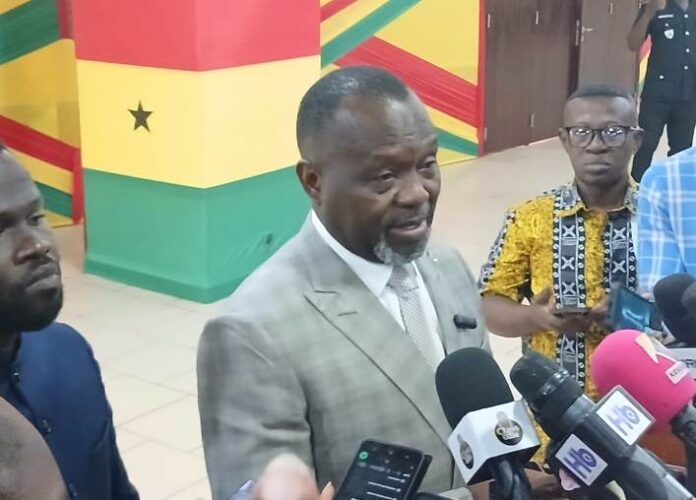

Attorney-General and Minister for Justice, Dominic Ayine, has defended the Tribunals Bill, 2026, assuring the proposed regional and district tribunals will operate strictly within the framework of the 1992 Constitution.
The tribunals, he said, will not replicate the excesses associated with public tribunals during previous military administrations.
According to him, the proposed legislation has been deliberately crafted to strengthen the administration of justice while protecting the fundamental rights of citizens
Also read: Speaker slams fear politics over Tribunals Bill 2026, calls for constructive and open-minded debate
Addressing the media on Tuesday after the House adopted the Report of the Joint Committee on Constitutional & Legal and Judiciary, the Attorney-General admitted that concerns raised by the Minority regarding the history of public tribunals were legitimate and had already been acknowledged in the memorandum accompanying the bill.
According to him, the government recognises that tribunals established in the past were associated with excesses that generated public concern.
He explained, however, that the new bill has been refined to align with constitutional safeguards, human rights protections and due process requirements.
“I was very transparent in owning up to the history of public tribunals in our country. If you read the memorandum to the bill, I acknowledged that the tribunals of the past engaged in certain excesses that Ghanaians were worried about,” he stated.
Oversight committee
Dr. Ayine disclosed that the bill also proposes the establishment of a Tribunals Oversight Committee under the supervision of the Judicial Council to monitor the operations of the tribunals.
The oversight mechanism, he said, should be decentralised to ensure effective monitoring across all regions.
Under the proposal, regional oversight committees will assess the work of tribunals and report any misconduct or abuse to the Judicial Council and the Chief Justice for appropriate action.
According to the Attorney-General, the oversight structure is intended to ensure that any misconduct is addressed promptly and transparently.
The Constitution
The Attorney-General stressed that the proposal is not a political initiative by the Mahama administration but a constitutional requirement already provided for under Articles 126 and 142 of the 1992 Constitution.
He explained that the Constitution prescribes the composition of district and regional tribunals, including a legally qualified chairperson and panel members who may or may not be lawyers.
For regional tribunals, he noted, the chairperson must be qualified to serve as a High Court judge. He added that where laypersons are appointed to serve on tribunal panels, they would be individuals of integrity and competence capable of contributing meaningfully to justice delivery.
Politically neutral
Responding to concerns that the tribunals could be used to target political opponents, Dr. Ayine rejected suggestions that the proposed judicial bodies would become instruments of political persecution.
He assured Ghanaians, including members of the opposition New Patriotic Party (NPP), that the tribunals would administer justice fairly and independently.
“The tribunals, when they are established, will not be targeting any particular political party. They will dispense justice in accordance with law, and they will be fair and transparent in the dispensation of justice.”
Faster justice delivery
Dr. Ayine maintained that the primary objective of the Tribunals Bill is to accelerate the administration of criminal justice and encourage greater public participation in the judicial process as envisioned by the Constitution.
He assured that the government remains committed to ensuring that the proposed tribunals operate within constitutional limits while strengthening confidence in Ghana’s justice system.
The Tribunals Bill, 2026, continues to generate vigorous debate in Parliament, with supporters arguing it will reduce case backlogs and improve access to justice, while critics caution against reviving institutions associated with Ghana’s past military rule.