

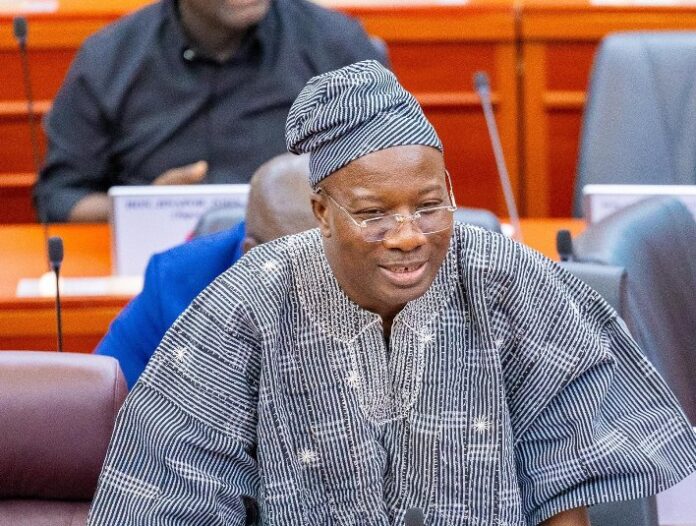

Majority Leader Mahama Ayariga has argued that Parliament has a constitutional obligation to operationalise regional tribunals as required under the 1992 Constitution.
He contended that Ghana has effectively been in breach of the Constitution for years by failing to establish regional tribunals as stipulated under Article 142.
According to him, the constitutional provision is mandatory, leaving the Chief Justice only with the responsibility of determining the number of regional tribunals to establish—not whether they should exist.
Also read: The Front pages: Thursday, 9th July, 2026 (Newspapers)
Contributing to debate on the Report of the Joint Committee on Constitutional and Legal Affairs and Judiciary on the Tribunals Bill, 2026, Mr. Ayariga told the House, “Article 142 of our Constitution says there shall be regional tribunals. Indeed, one might even say that we have been breaching the Constitution by not having regional tribunals.”
Constitutional mandate
The Majority Leader acknowledged that Parliament had previously amended legislation governing tribunals but argued that no amendment had been made to Article 142 of the Constitution itself.
He maintained that while statutory provisions had been altered over the years, the constitutional requirement for regional tribunals remained intact.
Mr. Ayariga also backed the proposal to establish district tribunals, describing it as consistent with the government’s decentralisation agenda and a practical way to improve access to justice.
The fears
Responding to concerns from the Minority that tribunal panel members could compromise justice, the Majority Leader said such fears were misplaced because tribunal chairpersons would possess the same qualifications as High Court judges.
He explained that regional tribunal chairpersons must be legally qualified to serve as High Court judges, while panel members may be lawyers or laypersons as permitted by the Constitution.
Drawing comparisons with jury systems in other jurisdictions, including the United States, Mr. Ayariga argued that involving ordinary citizens in justice delivery could strengthen public confidence.
The Majority Leader said the proposed tribunals would address widespread public concerns over delays in Ghana’s courts.
Citing findings from the Afrobarometer survey, he noted that many Ghanaians have expressed low confidence in the judiciary due to prolonged litigation and perceptions of corruption.
According to him, the Tribunals Bill introduces significant reforms, including mandatory day-to-day hearings, subject to exceptional circumstances, to ensure the speedy determination of criminal cases.
He argued that the current court system often suffers repeated adjournments, causing cases to drag on for years.
Environmental and criminal cases
Mr. Ayariga said the proposed tribunals would play a critical role in handling specialised criminal matters, particularly environmental offences such as illegal mining.
He noted that expediting prosecutions involving environmental destruction would strengthen Ghana’s fight against illegal mining and other serious crimes.
The Majority Leader urged MPs to support the bill at the second reading and work together during the consideration stage to refine any contentious provisions.
Calls for consensus
Speaker of Parliament, Alban Sumana Kingsford Bagbin, urged lawmakers to approach the bill with open minds and avoid allowing historical narratives to overshadow objective legislative scrutiny.
The Speaker encouraged Members to study Ghana’s political and judicial history carefully, arguing that previous legal reforms emerged in response to challenges faced during different periods of the country’s governance.
He acknowledged that aspects of the bill may require further refinement but stressed that Parliament has the constitutional mandate to improve legislation initiated by the Executive.
The House subsequently adopted the committee’s report and approved the Tribunals Bill, 2026 at the second reading.