

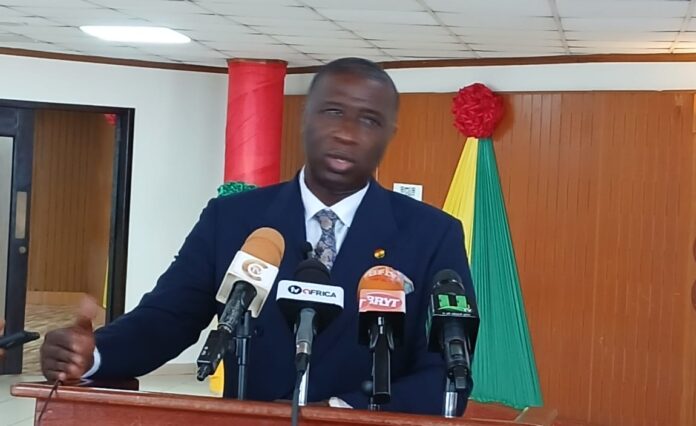

The Member of Parliament for Okaikwei Central, Patrick Yaw Boamah, has warned that Ghana’s new mining fiscal regime could negatively impact investment and job creation in the country’s critical extractive sector.
The lawmaker expressed strong reservations about the policy direction, arguing that the government must strike a balance between maximizing revenue and maintaining Ghana’s attractiveness to investors.
Government is implementing major 2025–2026 new mining reforms to boost local ownership and state revenue, including a new 12% sliding-scale royalty rate on gold (effective March 2026), a ban on foreign participation in small-scale gold trading, and stricter environmental controls. Key changes include a new medium-scale license, reduced lease terms, and enforced local content.
Also read: Rev. Stephen Wengam, wife build Legacy Temple for Paknatik Assemblies of God
The reforms, which matures today after 21 sitting days was laid by the Minister for Lands and Natural Resources on 19th December 2025.
Speaking in an interview on the issue in Parliament on Tuesday, the MP expressed misgivings about the regulations and the impact on the mining sector and investment in the country.
Hon. Boamah noted that recent global rankings suggest Ghana’s attractiveness to mining investors is already declining.
Citing data from the Fraser Institute’s mining policy perception index, he said Ghana’s standing in the global mining industry has worsened in recent years.
“In 2024 Ghana ranked 46th out of 82 countries. In 2025, Ghana ranked 53rd out of 68 countries. It tells you that mining investment is being sent to other countries,” he explained.
According to him, countries such as Peru, Colombia, South Africa, Côte d’Ivoire, and Mali are increasingly attracting new mining investments that could otherwise come to Ghana.
Patrick Boamah accused the government of failing to fulfill a promise made to mining companies to reduce the growth and stabilization levy from three percent to one percent.
“Government has not honoured its promise to the mining sector by reducing the growth and stabilization level from three to one percent,” he stated.
The absence of such relief measures, he said, could further deepen concerns among investors.
The Okaikwei Central legislator warned that the cumulative impact of the fiscal changes could lead to significant job losses and reduced economic activity.
He noted that the mining industry is capital-intensive and relies heavily on stable fiscal policies to attract the massive investment required for exploration and production.
“Mining is a very capital-intensive sector and we need to put in place the right fiscal regime to support mining companies to retain jobs and grow our economy,” he stressed.
He also cautioned that while government may seek to increase revenue through higher royalties, the broader economic impact could be severe.
“If the investment required does not come in, you will lose jobs and tax revenue. You are not going to expand the economy,” he said.
He warned that Ghana needs to remain competitive in the global mining landscape, especially as other resource-rich countries offer more favourable investment terms.
He argued that while it is important for Ghana to protect its national interest and revenue streams, policymakers must avoid creating conditions that push investors to other jurisdictions.
“You should always strike a balance to attract investors, create jobs over the long term and raise adequate revenue for the country,” he noted.
The MP urged the government to reassess the new mining fiscal policies and engage stakeholders more broadly to ensure that Ghana remains a preferred destination for mining investment.
According to him, the country’s economic growth, employment prospects and long-term revenue generation depend heavily on maintaining a stable and competitive investment environment in the mining sector.
“Rather than being too tight and forcing investors to leave for other parts of the world, we should create favourable conditions that sustain the economy,” he stressed.