

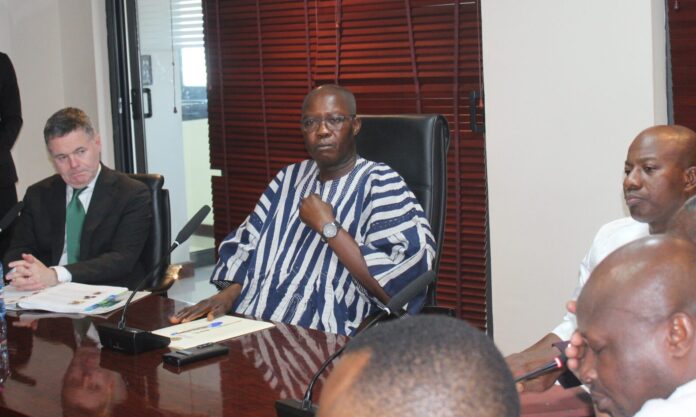

The First Deputy Speaker of Parliament, Barnard Ahiafor, has called for an expanded partnership between Ghana and the World Bank Group to further strengthen legislative oversight and economic governance.
He acknowledged the difficult economic environment facing Ghana, including fiscal constraints and debt sustainability concerns.
According to him, as Ghana continues to navigate a complex economic landscape, the role of Parliament in promoting prudent economic governance has become increasingly critical, and he stressed that strengthening the legislature is essential to ensuring long-term economic resilience.
Also read: The Front pages: Thursday, 19th March, 2026 (Newspapers)
Speaking at a high-level meeting in Parliament on March 18 with a World Bank delegation led by the Managing Director and Chief Knowledge Officer, Paschal Donohoe, the Deputy Speaker praised the World Bank and the UK’s Foreign, Commonwealth and Development Office (FCDO) for supporting the project titled “Building the Capacity of Parliament for Economic and Financial Governance.”
This initiative, he said, has proven both timely and impactful, particularly in the context of the evolving economic challenges confronting the country.
He outlined several key achievements under the programme, including training for the Budget Committee on the Public Financial Management Act and effective budget scrutiny, the maiden Speaker’s Public Financial Management Dialogue which brought together media and parliamentary leadership for strategic discussions, targeted capacity-building for the Committee on Economy and Development, as well as specialised training for the Parliamentary Press Corps (PPC) to enhance accurate and analytical reporting on economic issues, all of which are aimed at strengthening Parliament’s oversight role.
Hon. Ahiafor emphasized Parliament’s constitutional responsibility in ensuring accountability and prudent economic management.
“Our mandate to provide oversight of the Executive, scrutinize the national budget, and ensure accountability… is fundamental to good governance,” he said.
He noted, however, that the effectiveness of Parliament depends on strong institutional and technical capacity.
“It is in this regard that the support provided through this project has proven invaluable.”
He disclosed that a Project Steering Committee—chaired by himself—has been established to guide implementation, with membership drawn from key parliamentary committees.
The project currently targets seven critical committees, including the Public Accounts Committee, the Budget Committee, the Finance Committee, the Committee on Economy and Development, the Assurances Committee, the Ways and Means Committee, and the Public Administration and State Interest Committee, all of which play key roles in strengthening Parliament’s oversight and economic governance functions.
“These capacity-building programmes… constitute critical interventions for enhancing Parliament’s role in economic and fiscal governance,” he explained.
Looking ahead, the Deputy Speaker proposed broadening the scope of collaboration to include additional parliamentary committees and institutional reforms.
“We are keen to deepen this collaboration and explore additional avenues of support,” he said.
Key proposals include support for parliamentary committees not currently covered under the project, assistance for the Open Government Partnership (OGP) Caucus in strengthening transparency and accountability initiatives, as well as the digital transformation of parliamentary processes to enhance efficiency and accessibility. The proposals also cover strengthening data and knowledge management systems within Parliament and ensuring continuous professional development for Members of Parliament and staff to improve institutional capacity and performance.
The Deputy Speaker acknowledged the difficult economic environment facing Ghana, including fiscal constraints and debt sustainability concerns.
“Ghana… continues to navigate a complex economic landscape… the role of Parliament in promoting prudent economic governance has become increasingly critical,” he stressed.
He added that strengthening Parliament is essential to ensuring long-term economic resilience.
Reaffirming Parliament’s commitment to good governance, the Deputy Speaker expressed optimism about the future of the partnership.
“Parliament remains fully committed to promoting transparency, accountability, and sound economic governance in Ghana,” he assured.