
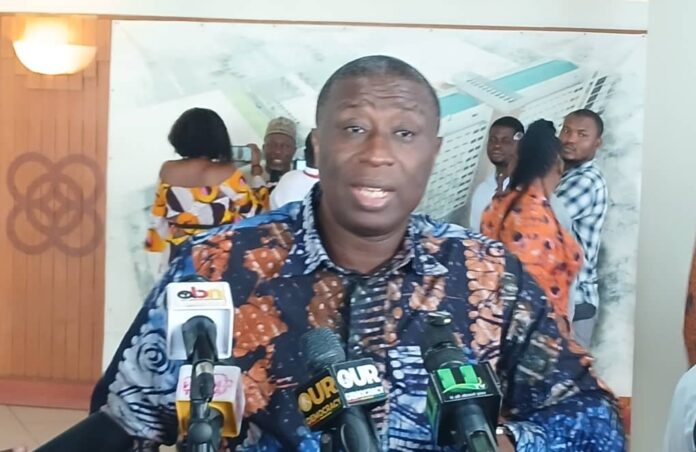

Member of Parliament for Okaikwei Central, Patrick Yaw Boamah, has called for sweeping reforms to Ghana’s tax administration system, warning that current audit practices are crippling businesses and undermining job creation.
He argued that tax audits, as currently implemented, have become punitive rather than corrective, leading to financial distress for many companies.
Speaking to the Parliamentary Press Corps (PPC) on Thursday, Hon. Patrick Boamah explained that under existing laws, the Ghana Revenue Authority (GRA) is mandated to audit businesses within six years after tax filings.
However, he noted that audits often occur two to five years later, by which time penalties and interest have accumulated significantly.
“They will come after two or three years to do tax audits and then tell you that some information you provided was not accurate, and that you are to pay interest and penalties,” he said.
He stressed that such delays, combined with high interest rates, are placing unbearable financial pressure on businesses.
Hon. Boamah criticized the current penalty regime, revealing that affected businesses may be charged interest rates of up to 125% of the Bank of Ghana’s monetary policy rate, compounded monthly and applied retrospectively.
“If you are caught by these tax audits, you are going to pay interest at a rate of up to 125%… with monthly compounding… it’s not helping the business community,” he stated.
This system, he said, has led to the collapse of some businesses, ultimately affecting employment in a country striving to create jobs for its youth.
The MP advocated a shift toward a more supportive and transparent tax system that encourages compliance rather than punishes errors.
“Tax audits must not be used as a means of punishment. Businesses must be encouraged to undertake proper reporting,” he said.
He emphasized the need for timely audits to detect errors early, ensuring that any penalties imposed remain minimal.
Patrick Boamah pointed to international best practices, citing countries like South Africa and Kenya as models Ghana could emulate.
According to him, South Africa uses a behaviour-based system that distinguishes between inadvertent errors, negligence, and deliberate tax evasion, while Kenya applies modest simple interest rates to prevent excessive debt accumulation.
The Okaikwei Centrail MP also raised concerns about alleged unethical conduct by some tax officials, claiming that certain auditors exploit gaps in the system to negotiate unofficial settlements with businesses.
“Some of them will go into unethical negotiations… if you give us this, we’ll be able to reduce it,” he alleged.
Boamah urged journalists to investigate these claims further by engaging businesses and tax professionals.
The legislator revealed that he has formally written to Minister of Finance Ato Forson, calling for urgent reforms to promote business growth and investor confidence.
“Let’s have a bipartisan discussion on this matter. If businesses survive, they pay taxes and create jobs,” he said.
He appealed to the media to amplify the conversation and push for reforms that would make Ghana’s tax system more transparent and business-friendly