

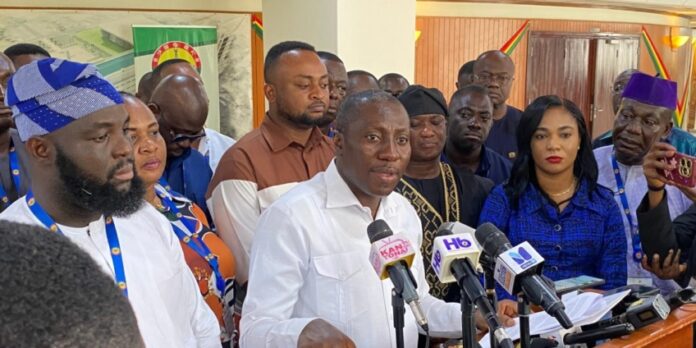

The Minority Caucus in Parliament has called on the government to urgently adopt a series of reforms aimed at addressing the growing financial challenges facing the Bank of Ghana (BOG) following reported losses of GH¢34.9 billion for the 2025 financial year.
The side maintained that the central bank’s actual operating loss could rise to GH¢44 billion when proceeds from gold sales are excluded from the calculations.
In a press statement issued on Thursday, May 7, the Caucus argued that the Bank of Ghana subsequently confirmed in a set of Frequently Asked Questions released on May 5 that its losses stood at GH¢34.9 billion.
Also read: Chairman Wontumi opens defence: Calls Mireku Duker as key witness in illegal mining trial
According to the Minority, the acknowledgment by the central bank vindicated concerns it had earlier raised regarding the deteriorating financial condition of the institution.
The Caucus outlined a fresh set of proposals to the government aimed at restoring confidence and financial stability at the Bank of Ghana amid growing concerns over the institution’s financial position and operational sustainability.
As part of its proposed solutions, the Caucus called for a transparent recapitalisation plan for the Bank of Ghana based on the terms of an existing Memorandum of Understanding between the Ministry of Finance and the central bank.
The proposed plan, according to the statement, should clearly indicate the total recapitalisation amount, annual funding tranches, financing instruments, maturity terms, coupon structures, budget implications, and parliamentary approval requirements.
The Minority also urged the government to formally incorporate the recapitalisation of the central bank into the country’s medium-term fiscal risk framework.
Additionally, the Caucus proposed the introduction of a recurring “policy solvency measure” that excludes one-off transactions such as refined gold sale gains, asset revaluations, and exceptional recoveries from the Bank’s operational performance calculations.
The statement further called for stronger disclosure standards regarding quasi-fiscal operations, including gold programmes, foreign exchange interventions, open market operation costs, and government-related receivables.
According to the Minority, Parliament and the public must be able to clearly distinguish between monetary policy operations and fiscal interventions.
The opposition also raised concerns over the management of gold transactions by the central bank, insisting that the Bank of Ghana should provide greater transparency on the sale of 18 tonnes of gold reserves.
It recommended that the central bank publish detailed information on the purpose of the transactions, approval processes, counterparties, settlement structures, and associated financial outcomes.
On the Domestic Debt Exchange Programme (DDEP), the Minority called for consistency in the accounting treatment of its impact across public debt statistics, fiscal accounts, and the Bank’s financial statements.
The Minority urged the International Monetary Fund (IMF) to support an independent technical review of certain accounting treatments adopted by the Bank of Ghana, particularly those relating to foreign exchange reserves, monetary gold accounting, and IMF-related off-balance-sheet arrangements.
The Caucus criticised previous recommendations that allowed monetary financing of government expenditure by the central bank, warning that such policies could negatively affect Ghana’s economy if left unchecked.
To improve transparency, the Caucus proposed the establishment of a quarterly fiscal-risk dashboard covering central bank equity levels, government deposits, recapitalisation progress, gold-related liabilities, and other contingent obligations.
The Minority stressed that the recommendations had already been submitted to the IMF review team currently in Ghana for the ongoing programme assessment.
It urged the government to avoid politicising the issue and instead focus on implementing practical reforms to restore confidence and financial stability at the Bank of Ghana.