

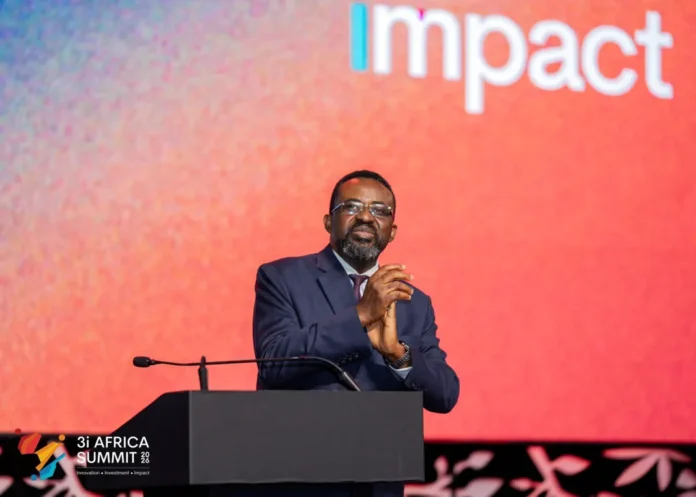

The Bank of Ghana plans to establish a continental fintech sandbox, launch a national innovation hub, and introduce a separate legal framework for fintech regulation, as the central bank steps up efforts to position Ghana as a regional digital finance hub.
Governor Johnson Pandit Asiama announced the measures at the close of the 2026 3i Africa Summit in Accra, where regulators, investors, and fintech operators discussed the next phase of Africa’s digital financial integration.
The proposed initiatives form part of a broader strategy to deepen Africa’s digital financial ecosystem, improve regulatory coordination, and support cross-border fintech growth across the continent.
Also read: Never forget Africa’s solidarity in anti-apartheid struggle – Zanetor to young South Africans
“Today, we are announcing our commitment to setting up the Innovation Hub that will harness and incubate all innovations, a separate legal framework for the fintech regulation, build a framework and launch the Continental FinTech Sandbox, and operationalise the National FinTech Inclusion Programme,” Dr. Asiama said in his closing keynote address.
The central bank’s planned continental sandbox is expected to provide fintech firms with a controlled regulatory environment to test products and services across multiple African jurisdictions, while supporting ongoing discussions around licence passporting and supervisory convergence among regulators.
Dr. Asiama said African policymakers must continue advancing the harmonisation of financial systems and regulatory standards to support the continent’s integrated digital finance agenda.
“The work of harmonisation of financial systems, of licence passporting, of supervisory convergence will not be buried under these conversations. We have to continuously champion and support its advancement,” he said.
The announcements come as Ghana seeks to consolidate macroeconomic stability while accelerating digital financial reforms. Asiama said the Ghana cedi had remained stable over the past year and appreciated against major currencies, while inflation slowed to 3.4 percent in April 2026, one of the lowest levels recorded since the country adopted inflation targeting.
Ghana’s economy expanded by 6.0 percent in 2025, according to the governor, supported by policy interventions aimed at restoring confidence and strengthening financial sector resilience.
The governor also pointed to recent regulatory reforms, including the passage of the Virtual Asset Service Providers Act, 2025 (Act 1154), which provides a legal framework for digital asset operators.
The central bank has additionally issued a directive for digital credit service providers and amended its Cyber and Information Security Directive to strengthen resilience against cyber threats within the financial sector.
The measures signal a shift toward more formalised oversight of digital finance activities as African regulators attempt to balance innovation with financial stability and consumer protection.
The 3i Africa Summit, organised by the Bank of Ghana in partnership with Ghana Interbank Payment and Settlement Systems Limited and Global Finance & Technology Network, focused this year on ‘The Next Frontier: Shaping Africa’s Integrated Fintech Future’.
Dr. Asiama said discussions at the summit reflected renewed investor and policy confidence in Africa’s digital finance sector, but cautioned that implementation would determine whether the continent can translate fintech growth into sustainable economic gains.
He also called for long-term investment partnerships, saying Africa’s financial technology ecosystem requires “patient capital” and stronger institutional collaboration to scale innovation across the continent.
BFT