

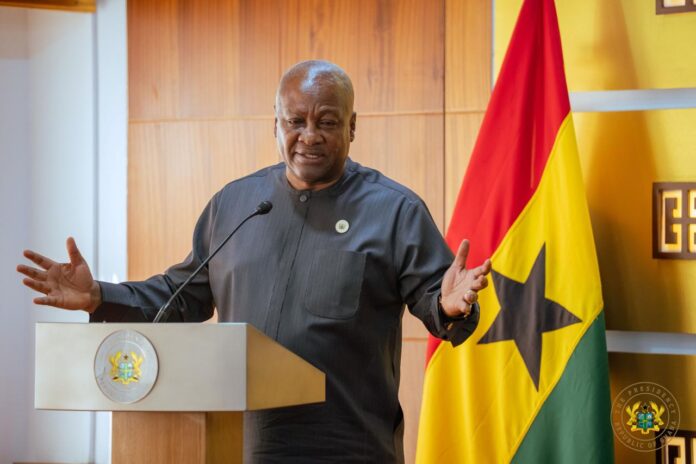

President John Dramani Mahama has announced that the government will phase out the double track system in senior high schools (SHSs) by 2027, backed by a $300 million World Bank facility under the Transformative Secondary Education for Access, Results and Relevance for Jobs (STARR-J) project.
The initiative will see 30 category C schools upgraded to category B, and 20 category B schools upgraded to category A.
Speaking in Accra last Wednesday, the President gave a firm commitment: “By 2027, there should be no secondary school implementing a double track system in Ghana.”
Also read: No more loans: Ghana exits IMF programme, launches new reform era
“The STARR-J project is going to assist the Ghana government in achieving its target of bringing an end to the double track in our secondary school system by next year,” President Mahama stated.
He added that the programme had been designed to expand educational infrastructure, improve quality, and widen access to secondary education across the country.
“This strategic investment is not simply about expanding infrastructure; it is fundamentally about promoting equity, improving quality, and widening opportunities for every Ghanaian child,” President Mahama stressed.
The investment will also cover reviving and operationalising the community day school concept through the construction of new E-blocks in urban and peri-urban communities.
“These are going to be community day schools, but they are going to be built in urban communities where it will be easy for the children to commute to school and back,” he explained.
“What this means is that if we get some of the children to go to school within their communities, it will ease the pressure on the boarding schools that are elsewhere,” he added.
The President expressed optimism that the policy would reduce pressure on boarding facilities in existing senior high schools.
He added that ending the system would also improve teaching and learning outcomes by giving teachers more time to prepare adequately.
President Mahama also revealed that the programme would include continuous professional development for teachers to equip them with modern teaching skills and digital competencies, including digital literacy and artificial intelligence integration.
On teacher career progression, the President said advancement to senior ranks was no longer dependent on the availability of administrative positions.
“Teachers can now progress on merit, competence, experience, performance, and years of dedicated service,” President Mahama said.
The double-track system was introduced as a direct consequence of the Free Senior High School (Free SHS) policy, launched in September 2017.
Following the policy’s implementation, student enrolment in public senior high schools surged by more than 30 per cent, exposing a critical shortage of classrooms, dormitories, and other facilities.
To avoid turning away qualified students or compromising the quality of instruction, the government of President Nana Akufo-Addo adopted the double-track system as a stop-gap measure. The system commenced on Tuesday, September 11, 2018, for the 2018/2019 academic year, initially covering 400 out of 696 public SHSs.
It was implemented under the leadership of the then Minister of Education, Dr Matthew Opoku Prempeh, who argued that the arrangement would allow schools to absorb increased numbers without waiting years for new infrastructure.
Under the double-track system, students were divided into two cohorts—initially named the Green Track and the Gold Track. While one track was on campus receiving academic instruction, the other was on a scheduled break, alternating in intervals of about three months.
While the system made it possible to increase student access, education stakeholders expressed concern about the long weeks spent at home, which exposed children to social vices. Parents, teacher unions, and opposition politicians criticised the disruption to family routines, the accelerated curriculum, and the strain on both students and staff.
Following the change of government, President Mahama has made phasing out the system a central priority. Citing the negative impact on students, teachers, and parents, the government has also allocated GH¢1 billion from the Ghana Education Trust Fund (GETFund) to complete stalled infrastructure projects in affected schools.
The stated goal is to end the double-track system entirely by 2027, returning all SHSs to a single-track, year-round academic calendar.