

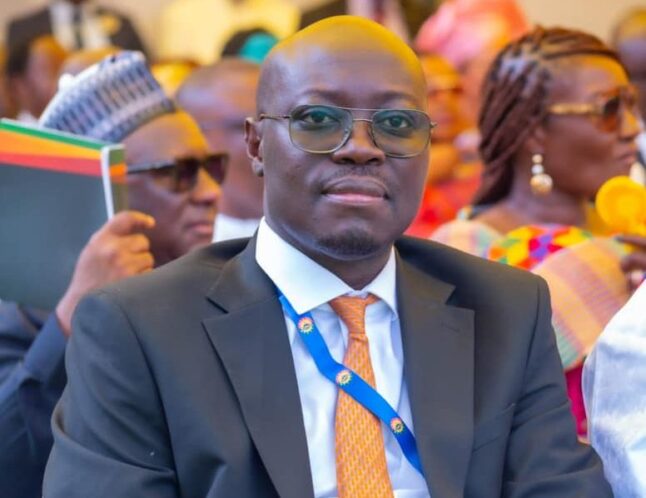

The Minister for Finance, Dr Cassiel Ato Forson, has declared that Africa’s future relevance in the global economy will depend on its ability to industrialise, deepen digital transformation, strengthen governance systems, and build competitive regional trade networks.
Africa, he said, stands at a defining historical crossroads where the continent must decide whether to remain dependent on exporting raw materials or become a global force in production and value addition.
The Minister made the call in a keynote address at the 12th Ishmael Yamson & Associates Business Roundtable in Accra on the theme, “Unlocking the Next Quarter Century: Harnessing Africa’s Digital Infrastructure, Trade & Integration, Energy & Industry, Governance, and Societal Development for Global Relevance.
Also read: Weija Dam spillage: Jerry Ahmed Shaib cries for urgent help as flood sictims struggle
The Finance Minister stressed that Africa’s economic tragedy over the years had not been a lack of resources but the continuous export of value and import of dependency.
“For centuries, we supplied the world with raw materials, labour, and strategic resources. However, we captured only a fraction of the value created from them,” he stated.
According to him, Africa risks repeating the same cycle in the digital age if urgent steps are not taken to build a strong continental digital infrastructure and protect Africa’s economic sovereignty.
“Our raw materials still leave. Increasingly, our data leaves,” Dr Ato Forson warned.
He noted that the next phase of Africa’s transformation would largely depend on investments in infrastructure, including commercial agriculture, energy, transport and logistics, digital systems, financial infrastructure, and human capital development.
Dr Ato Forson observed that despite the establishment of the African Continental Free Trade Area (AfCFTA), intra-African trade still accounted for only about 15 percent of the continent’s total trade, compared with nearly 70 percent in Europe and more than 50 percent in Asia.
“That statistic alone should provoke urgent reflection. Why should it take longer and cost more to move goods from one African border to another than across oceans?” he questioned.
On digital transformation, the Finance Minister argued that nations that control digital ecosystems, data infrastructure, and payment systems would shape the future global economy.
He therefore called for a continental digital strategy focused on regional data centres, affordable broadband expansion, cross-border digital payments systems, cybersecurity, artificial intelligence readiness, and digital skills development for Africa’s growing youth population.
“Africa cannot afford to become just a consumer in the digital age,” he stressed.
Dr Ato Forson further highlighted the central role of energy in Africa’s industrialisation agenda, lamenting that more than 600 million Africans still lacked access to electricity despite the continent’s vast natural resource endowment.
“How can Africa speak meaningfully about industrialisation without reliable and affordable power?” he asked.
He disclosed that Ghana is targeting 3,000 megawatts of installed electricity generation capacity by 2030, with at least 40 percent expected to come from renewable energy sources.
Touching on industrialisation, Dr Ato Forson urged African countries to move beyond exporting raw commodities to building competitive value chains.
“Not just extracting lithium. But refining lithium and not just exporting bauxite. But producing aluminium and not just exporting cocoa. But processing and building competitive value chains,” he emphasised.
The Finance Minister also stressed the importance of governance reforms, fiscal discipline, policy predictability, transparency, and institutional credibility in attracting investment and sustaining long-term economic transformation.
“Investors do not just invest in resources. They invest in systems,” he said.
Dr Ato Forson warned that Africa’s rapidly growing youth population could either become a demographic dividend or a demographic emergency depending on the continent’s ability to create jobs, drive productivity, and support innovation.
By 2050, he noted, one in every four people in the world would be African, making it critical for African leaders to prioritise education, entrepreneurship, and industrial competitiveness.
“The global relevance of Africa will not be gifted to us. It must be built deliberately through integration, industrialisation, digital transformation, energy security, strong institutions, and strategic leadership,” he stated.
He urged African governments, businesses, academia, innovators, and civil society to think beyond short-term political cycles and focus on long-term continental transformation.
“The next quarter of a century belongs to those prepared to build it. Let Africa build it. Let Ghana lead it,” Dr Ato Forson declared.