


Spain’s historic 2026 FIFA World Cup final victory over Argentina should have been remembered as one of the defining moments in the country’s football history.
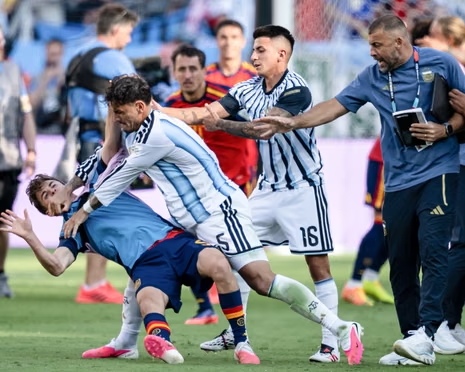
Instead, the celebrations were overshadowed by ugly scenes after the final whistle, as players from both teams became involved in a heated confrontation that marred an otherwise dramatic World Cup final.
Spain defeated defending champions Argentina 1-0 after extra time to win their second FIFA World Cup title, but the post-match clashes quickly became one of the most talked-about moments of the night.
Also read: The Front pages: Wednesday, 22nd July, 2026 (Newspapers)
For 120 minutes, the Spain vs Argentina World Cup final showcased the best qualities of elite football—tactical discipline, resilience, intensity and moments of individual brilliance.
But within moments of the final whistle, the atmosphere inside MetLife Stadium changed dramatically.
Spain’s triumph capped a remarkable campaign and confirmed the country’s return to the summit of international football.
The Spanish side remained composed throughout a fiercely contested encounter, eventually finding the decisive breakthrough in extra time when Ferran Torres scored the winning goal.
The victory sparked wild celebrations among the Spanish players, who raced across the pitch to celebrate their country’s second World Cup triumph.
For Argentina, however, the defeat marked a painful end to their title defence.
The tension that had characterised the match appeared to boil over after the final whistle, turning the 2026 World Cup final into an unexpected spectacle.
As Spain’s players celebrated, members of the Argentine team confronted their opponents in scenes that quickly attracted global attention.
Midfielder Leandro Paredes became a central figure in the confrontation after reportedly grabbing Spanish defender Eric García and wrestling Gavi to the ground.
Nahuel Molina was also reported to have attempted to confront Spanish players, while substitutes and members of both coaching staffs entered the pitch as officials struggled to restore order.
The confrontation lasted only a few minutes but was enough to overshadow the immediate aftermath of Spain’s historic victory.
The scenes raised questions about player discipline and sportsmanship at the highest level of international football.
Argentina manager Lionel Scaloni, visibly emotional following the defeat, moved to separate players and calm the situation.
His intervention helped prevent the confrontation from escalating further, although disciplinary action followed.
Paredes was shown a red card after the final whistle as officials sought to regain control of the situation.
The incident has reignited an old debate in international football: where should the line be drawn between competitive passion and unacceptable behaviour?
Football has always been a sport driven by emotion.
A World Cup final represents years of preparation, sacrifice and expectation compressed into a single match. Players carry not only their personal ambitions but also the hopes of millions of supporters.
That immense pressure can produce extraordinary moments of courage and brilliance.
But the greatest teams are also judged by how they respond when things go wrong.
The Spain vs Argentina final demonstrated both sides of football’s emotional power. Spain celebrated an historic victory, while Argentina faced the pain of losing the biggest match in international football.
Yet the scenes after the match provided an uncomfortable reminder that intense competition can sometimes cross the line.
The post-match confrontation also highlighted the challenges facing football’s governing authorities.
FIFA has invested heavily in promoting respect and fair play, with messages encouraging players and supporters to uphold the values of the sport.
However, when the pressure of a World Cup final reaches its peak, those principles can be tested.
Former players and television pundits were quick to criticise the confrontation, arguing that the scenes distracted from what had otherwise been an exceptional final.
Concerns were also raised about the example set for young football supporters watching the World Cup final around the world.
For Spain, the controversy will not erase what an outstanding tournament was.
The team combined tactical discipline, defensive resilience and collective teamwork throughout the competition.
Their 1-0 victory over Argentina secured Spain’s second World Cup title and marked a significant moment in the nation’s football history.
The triumph also reaffirmed Spain’s status as one of the world’s leading football nations.
For the Spanish players and supporters, the night will ultimately be remembered for Ferran Torres’ decisive goal and the lifting of the World Cup trophy.
For Argentina, however, the final images of the tournament may prove more difficult to forget.
Instead of ending the competition with scenes of mutual respect between two outstanding finalists, the tournament concluded with disciplinary action and renewed debate over player conduct.
Argentina’s defeat was already a painful moment for the defending champions.
The post-match confrontation added another layer of controversy to an evening that should have been defined exclusively by football.
Football’s greatest victories deserve unforgettable celebrations.
Its defeats, however, deserve dignity.
The 2026 FIFA World Cup final offered a powerful reminder of both the beauty and the darker side of the world’s most popular sport.
As the confetti settled inside MetLife Stadium and Spain lifted the World Cup trophy, history recorded a new champion.
But alongside the images of Spanish triumph, another picture remained: a reminder that in sport, character is often judged not only by how teams celebrate victory, but also by how they accept defeat.
By Frederick Ayisi-Acquah
University of Media, Arts and Communication
Class: Level 300
Email: frederickayisiacquah10@gmail.com